UAP
The Black Triangle Files: What the Newest Pentagon Release Actually Says
By Darrell Wallen
Would you prefer to listen?
The Department of War's seventh PURSUE release, posted October 23, 2026, includes an AARO memo and an FBI form describing a silent, matte black triangle that federal agents say they saw rise over a ridge, hover and race into a canyon earlier this year. The two documents agree on shape, silence and general size, and disagree on the time, the duration, whether there was a hover and what to call the object. Neither identifies it. A separate near miss near Heathrow, reported in the same news cycle, is a different case.
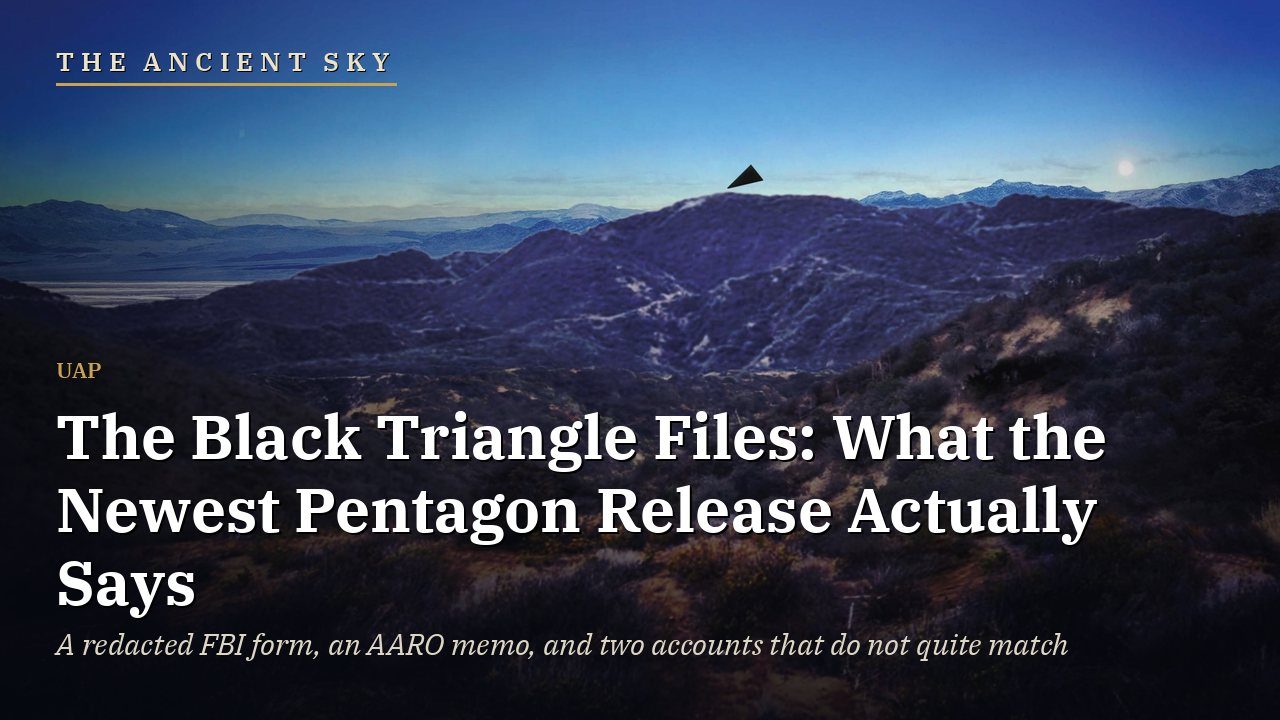
The Department of War posted two documents on Friday, October 23, 2026, that describe what trained federal agents say they saw one evening this year: a flat, matte black triangle that climbed over a ridge without a sound, stopped, and then vanished into a canyon. The release is the seventh under the Pentagon's PURSUE program, which began publishing government records on unidentified anomalous phenomena in May.
One document is a three-page memorandum for record from the Pentagon's All-domain Anomaly Resolution Office, known as AARO, numbered DOW-UAP-D176. The other is an FBI form, FBI-UAP-D043, that reproduces a signed statement from agents who watched the object. They describe the same event. They do not say exactly the same thing.
In the days that followed, headlines also described a Boeing 777 leaving Heathrow, a report from the UK Airprox Board, and an unknown object that passed within about fifty feet of the wing. That is a separate incident, and this article treats it separately.
What follows is what the two documents say, where they disagree, how black triangle reports have been received in the past, what ordinary explanations would and would not cover, and what a real investigation would require. A two-page memo is not an investigation. Some details in the version of this story now circulating online also do not match the documents, and those are corrected below.
A note on sourcing. The war.gov site refused to serve its files to this reporter's connection, so the originals could not be downloaded from the Pentagon's own servers. Both documents were read in full from a public mirror that lists a checksum for each file, and the files read match those listed checksums. They could not be compared against a checksum from war.gov itself. The text of the AARO memo also matches the extraction published by UAP Ledger, and the FBI statement's key figures match reporting by Fox News and NHI Anomalous.
§ 1What was released, and what was not
The release is dated October 23, 2026, and is the seventh since the program began in May. Scientific American noted that, unlike earlier releases, this one has no videos and no images. NHI Anomalous and the release listing at UAP.GLOBAL both count twenty-eight records, all PDFs, from 1949 to 2026. Axios described the batch as ten documents, so counts differ between outlets.
Most of the records are old, ranging from 1949 to about 2010. The two that made headlines are the recent ones: D176, the AARO memo, and FBI-UAP-D043, the FBI form.
A caveat sits at the top of the AARO memo. Its overview says the report reflects the reporter's interpretation at the time of the event, and that such characterizations should not be interpreted as a conclusive indication of the presence or absence of any intrinsic object features or performance characteristics. In plain English, this is what witnesses said they saw, written down by a debriefing team. It is not a measurement.
§ 2The AARO memo, point by point
The memo is a debrief, not an analysis of data. It names two primary interviewees, Source 1 and Source 2, and a corroborating witness, Source 3. Names, the date and the place are redacted. It says federal law enforcement agents documented the object at 2023 local time, which is 8:23 in the evening.
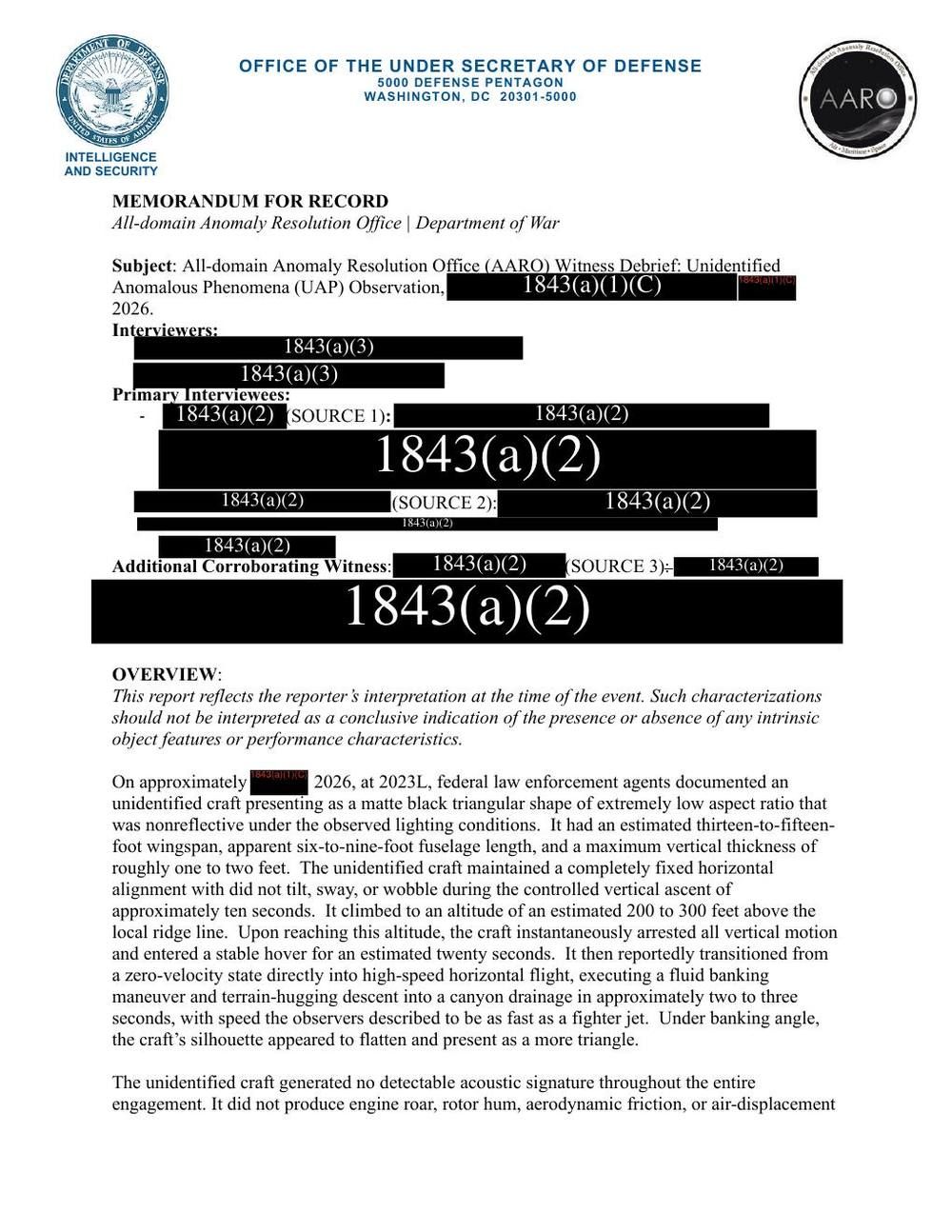
Conditions, according to the memo, were favorable. Visibility was unrestricted, cloud cover negligible, and it was late dusk, with the sun below the western horizon and a residual glow behind the ridge lines. The primary camera and tripod-mounted thermal systems were aimed east. At 2023, Source 3, scanning west with long-range thermal equipment from a second post, saw an elevated object cross a ridge and radioed it in. Sources 1 and 2 ran across the peak to get a western view. Source 2 carried binoculars and a handheld thermal monocular and picked the object up with the naked eye against the western sky.
The memo splits the event into three phases. In the first, about ten seconds, the object rose in a slow, perfectly vertical climb, with no tilting, swaying or wobbling, to an estimated two to three hundred feet above the ridge. In the second, about twenty seconds, it stopped all vertical motion and held a stable hover with no drift. In the third, two to three seconds, it went from hover to rapid horizontal flight, banked, and dropped into a canyon in what the memo says resembled low-altitude terrain masking. The witnesses compared the speed to that of a military fighter jet. In the memo's own words, no instrumented speed measurement was obtained.
The size is given as an estimated thirteen to fifteen feet of wingspan, six to nine feet of length, and one to two feet of thickness. The witnesses heard no engine noise, rotor hum or air-displacement sound. Through the thermal monocular the object showed a spatially uniform signature, with no hot spots or exhaust plume. Through binoculars, the witnesses saw no windows, panels, rivets, canopy or propulsion openings. No physiological effects or electromagnetic interference were reported. The thermal track was lost because the sudden acceleration exceeded the monocular's narrow field of view, and the object was last followed by eye into canyon shadow. A ground survey the next morning found no wreckage, scarring or vegetation damage.
Then there is the collector note, which nearly every account quotes. Sources 1 and 2 have extensive operational experience working alongside government agencies and academic studies that use unmanned aerial systems. They said that on this hilltop even a conventional Group 1 drone, a high-torque quadcopter motor or a rotary-wing aircraft at 1.4 miles would have been clearly audible. They compared the craft's outline against trees along the ridge behind it for scale, which the memo calls a reliable physical reference.
Notice what is not in the memo. There is no radar data, no recorded infrared video, no photograph and no engineering analysis. And the range to the object is described as bounded between approximately 1.4 and 3.2 miles, a spread of more than a factor of two.
§ 3The FBI statement, and where the two disagree
The FBI document runs eleven pages. Two pages are text, and nine are full-page images of a hillside scene. The text is an FD-302, the form agents use to record information. It says the FBI received a written statement from a special agent, co-signed by another, and reproduces it verbatim. One point of care applies here. In the visible text, the witnesses' employing agency is redacted. The form says the FBI received the statement. Many headlines say FBI agents saw the object. That may be true, but the document does not say so in so many words.
In substance the statement says this. At approximately 1923 hours, an agent at a post several miles west called out a thermally elevated aerial object on a bearing of 251 degrees. The writer and a colleague ran to the western side of their own post and almost immediately saw what they describe as a substantial, nonreflective, dark black triangular object most resembling a delta wing drone. They estimated the wingspan at approximately nine to fifteen feet, the depth at six to nine feet and the thickness at one to two feet. Through a handheld thermal device it appeared hotter than ambient temperature, with a completely consistent thermal signature across the airframe and no visible exhaust gases, while the other agent tracked it unaided.
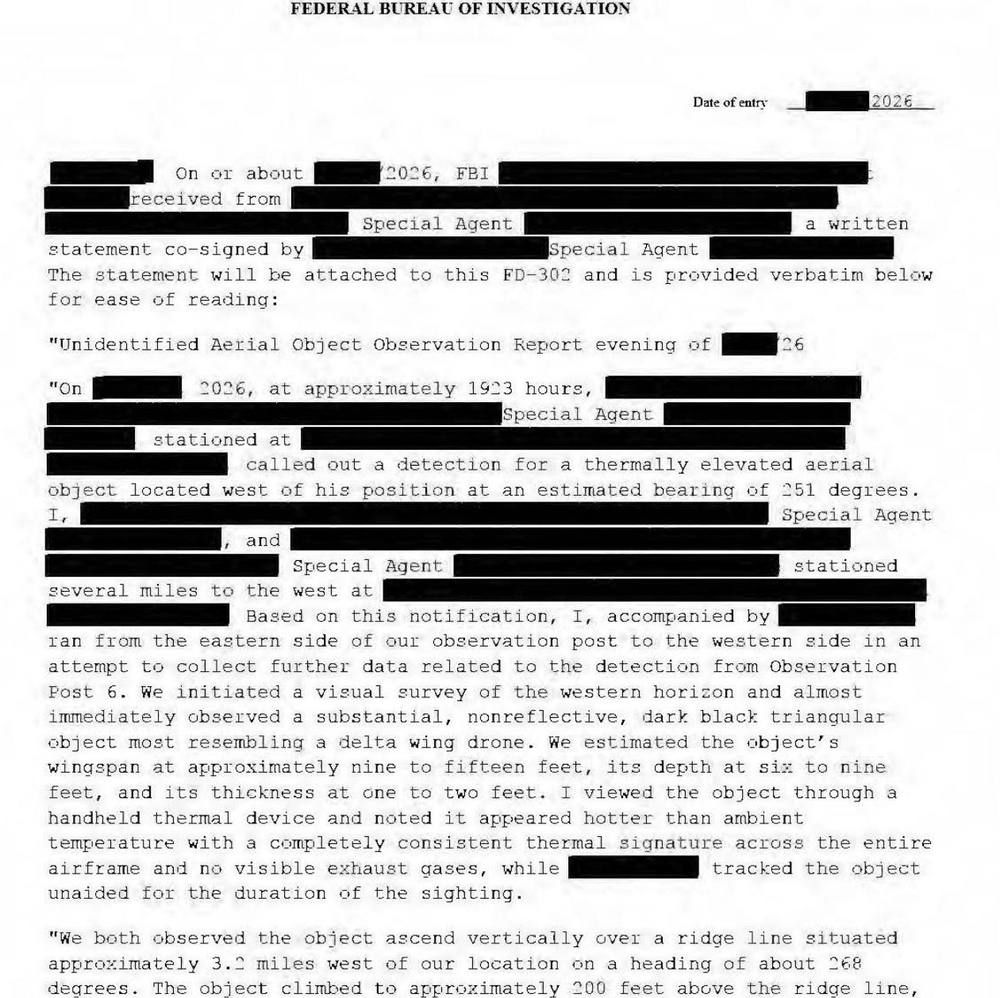
According to the statement, the object ascended vertically over a ridge about 3.2 miles west, on a heading of about 268 degrees, climbed to approximately 200 feet above the ridge, then transitioned to horizontal flight at what the writers call a very significant velocity, approaching their position. It then descended southeast into a redacted feature. The agents lost visual contact at an estimated range of about 1.5 miles. The total duration of the sighting was approximately three seconds. Neither agent heard any sound from what the statement calls the unmanned aerial system.
The places where the two documents do not line up are the part of this story that matters most.
The time. The FBI says approximately 1923. The memo says 2023. That may be a typo or a time zone slip between two offices. But 7:23 in the evening in June, the month the release index gives for the event, falls before sunset almost everywhere in the lower forty-eight, while the memo describes a sun that had fully set. The location is redacted, so the question cannot be settled from the public record, but an analyst would want it settled.
The duration. The FBI says the whole sighting lasted about three seconds. The memo's phases add up to roughly thirty-two seconds.
The hover. The FBI statement never mentions one. It describes a vertical ascent and a transition to horizontal flight. The twenty-second hover in so many headlines comes from the AARO memo alone, and it does not fit inside a three-second sighting.
The size. The FBI says nine to fifteen feet of wingspan. AARO says thirteen to fifteen. The popular phrase "nine to fifteen feet" is the FBI's number, not the memo's.
The vocabulary. The FBI statement says delta wing drone and calls the object an unmanned aerial system. The memo calls it an unidentified craft and uses the word drone mainly to explain why the witnesses believed it was not one.
The speed. A widely shared version says the object covered a mile and a half in three seconds, which works out to about eighteen hundred miles an hour. Axios, for one, wrote that the craft flew about a mile and a half in three seconds. Neither document says that. In the FBI statement, 1.5 miles is the estimated range from the observers at the moment they lost sight of the object. That is distance from them, not distance flown. The memo says speed was estimated from how far the object traveled along the ridge, with no instrumented measurement. So fighter-jet speed is a witness impression, and eighteen hundred miles an hour is someone else's arithmetic.
The place. Neither document gives a location. Redactions cover it. The release index, as read by NHI Anomalous and UAP Ledger, lists the western United States, and Axios described a secure facility. Those descriptions come from outside the two documents, and the documents themselves say only that the object was seen to the west of the observers.
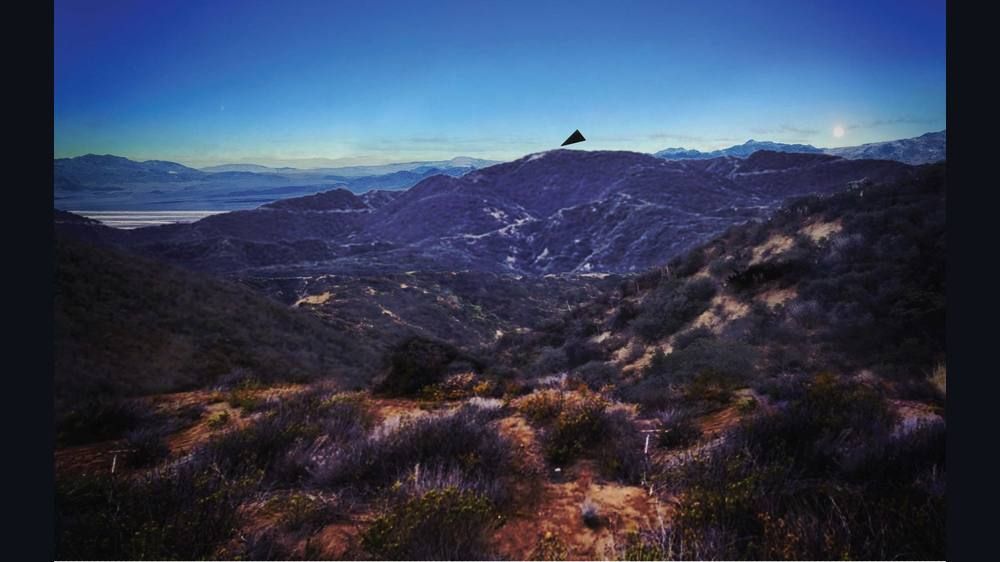
About those nine photo pages. They show one hillside scene, repeated, with a small flat black triangle appearing in some frames at different positions in the sky. They are not photographs of the object. NHI Anomalous describes them as a reconstruction drawn onto a daytime photo of the terrain, and the pages themselves carry no label. They should be treated as illustration.
§ 4The Heathrow near miss
The second story is the one headlines tied to the first. The UK Airprox Board is the joint civil and military body that assesses near misses in British airspace. For its meeting on September 16, 2026, it published a consolidated summary of thirteen reports involving drones, balloons, models and unknown objects. One was rated Risk A, two Risk B, seven Risk C and three Risk D.
The Risk A case is Airprox 2026127. On June 24, 2026, at 12:08 UTC, a Boeing 777 climbing out of Heathrow, passing 5,800 feet about four nautical miles north-east of Guildford, met a shiny silver object that the pilot described as likely a mid-size drone. It passed in the opposite direction, very fast and very close to the right wing, at no more than fifty feet above the aircraft's altitude. Press reports name British Airways as the operator. The controller's account adds that, when asked about size, the pilot said it was about the size of four toasters. NATS Safety Investigations reviewed the radar and found no contacts associated with the object.
The Board said the reported altitude and description were such that it could not determine the nature of the unknown object. Its risk statement says the Board considered that providence had played a major part in the incident and, or, that a definite risk of collision had existed. That is the most serious category the Board uses.
Three points of correction apply. The encounter happened on June 24, not in the week of the Pentagon release. The news reached the press in late October, after the Board published its sheet. The pilot himself said the object was likely a mid-size drone, and the Board did not call it anything extraordinary. "Unable to determine the nature" is its standard wording for such cases, and other entries on the same sheet carry the line that the description indicated it could have been a drone. And at least one outlet garbled the risk category, saying both that there was no risk and that the event was graded A.
The two stories share a word, "unknown," and a season, and nothing else that the record shows. Heathrow is useful as a baseline. Unidentified does not mean unusual. At one meeting the Board had thirteen of these reports to assess.
§ 5Black triangles before this one
"Black triangle" is a loose label rather than one phenomenon. It covers reports of dark triangular or V-shaped objects, usually at night, often described as large, silent and slow, sometimes with lights, which is how HISTORY's survey of the reports describes them. Two famous waves give the background.
In Belgium, the wave began on the evening of November 29, 1989, near Eupen, where gendarme patrols reported large triangular objects, according to the Belgian broadcaster RTBF. Reports continued for months. On the night of March 30 and 31, 1990, radar tracked targets and two F-16s made nine interception attempts over about fifty minutes. The Belgian Air Force's own report says the pilots had brief radar contacts, locked on in three cases for a few seconds, and never had visual contact. The Air Force backed the civilian group SOBEPS in its inquiries, and General Wilfried De Brouwer later called the wave exceptional while saying he did not claim an extraterrestrial origin. Skeptics, as Skeptoid summarizes them, say the three locks were the fighters picking up each other, that the other contacts were atmospheric radar echoes, and that many reports followed media coverage. The famous Petit-Rechain photograph, a black triangle with three lights, was admitted in July 2011 by its photographer, Patrick Maréchal, to be a hoax made from a polystyrene model.
In Arizona, on March 13, 1997, thousands of people saw lights, some in a V. In July 1997 the military said the later lights were flares dropped by Maryland Air National Guard A-10s, and skeptics say the earlier V was A-10s in formation. Three months later Governor Fife Symington held a press conference at which his chief of staff appeared in an alien costume. In 2007 Symington said he had seen an enormous and inexplicable craft himself.


§ 6Then and now
Reports of this kind were received very differently then. In Belgium, with open cooperation from the military but unresolved questions. In Arizona, with a joke from the governor. Across most of that era, witnesses were ridiculed or ignored, and the people who took reports seriously were mostly civilian groups.
The posture has changed. The government now posts files on a rolling schedule. Trained observers appear in an official memo. AARO is a standing office. Avi Loeb of Harvard, introduced by NewsNation host Blake Burman as chair of the UAP Science Advisory Council, said in a televised interview on October 23 that the data in the releases is not good enough, and that he hopes to partner with the Pentagon to put better sensors where the objects are seen. Scientific American quotes his blog post calling the fundamental question whether the object was manufactured by an adversary as a black project or came from an extraterrestrial source. The council's status could not be independently confirmed here, so the description is attributed to those who used it.
The reaction is mixed. Scientific American noted that earlier releases met skepticism from researchers who said much of the material had been seen before or had context omitted. Axios went beyond the documents when it wrote that the object counts as a UFO-like phenomenon because the United States lacks the technology to make such a craft, and so do its adversaries. Nothing in either document says that.
What unites the old reactions and the new is simple: a memo is not an instrument. In Belgium there was radar, and the question stayed open. Here there is a written statement and a thermal monocular that lost the object.
§ 7How drones and misidentification could and could not explain it
The ordinary explanations deserve a fair hearing, and so does the point where they strain.
A drone is the first candidate. The FBI statement itself says delta wing drone. A flat, dark, delta-shaped object of this size, flying at dusk without lights near a place with drone traffic, would be unremarkable if the observers had not said it could not be one. Drones can climb vertically, hover and leave quickly. Some fixed-wing designs take off and land vertically. Nothing here claims it was a drone. The point is that "rose and hovered" does not by itself rule one out.
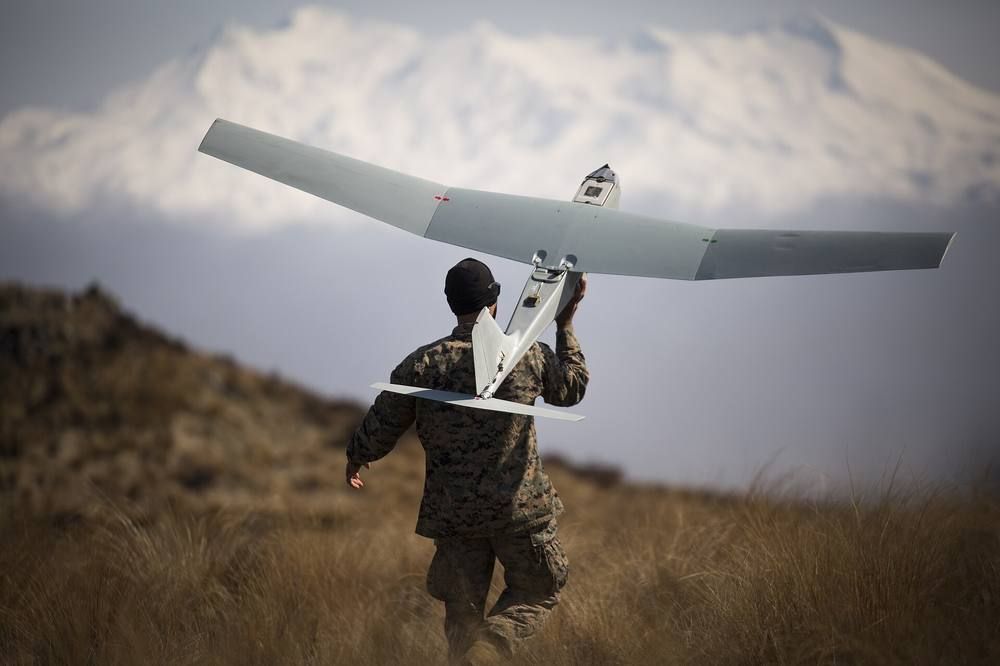

The collector note argues otherwise. A Group 1 drone, the Defense Department's smallest category, covering aircraft of twenty pounds or less, would be audible at 1.4 miles, the observers said. That deserves real weight, because they know the site. But it is a judgment made in the moment, hearing depends on wind, terrain and propeller type, and the range itself might be anywhere up to 3.2 miles, where almost nothing small is audible.
Size and distance. A dark silhouette's size cannot be judged without knowing its range, because a smaller object nearby and a larger one farther away look alike. The witnesses compared the outline to trees on the ridge. But trees on a ridge are at the ridge's distance. An object closer than the ridge would look larger against them than it is. This is the oldest trap in these reports, and it is raised here as a possibility, not a conclusion.
Speed. A small object seen for two or three seconds at a few miles can seem faster than it is. Humans are poor judges of speed without a reference, and the memo says plainly that there was no measurement.
The thermal signature. A handheld thermal monocular has a small sensor. At a mile and a half or more, a fifteen-foot object covers only a handful of pixels, and "spatially uniform" is what a handful of pixels looks like. That is reasoning, not a finding. The FBI statement also says the object appeared hotter than ambient, which is what one would expect from a powered aircraft with a motor and a battery.
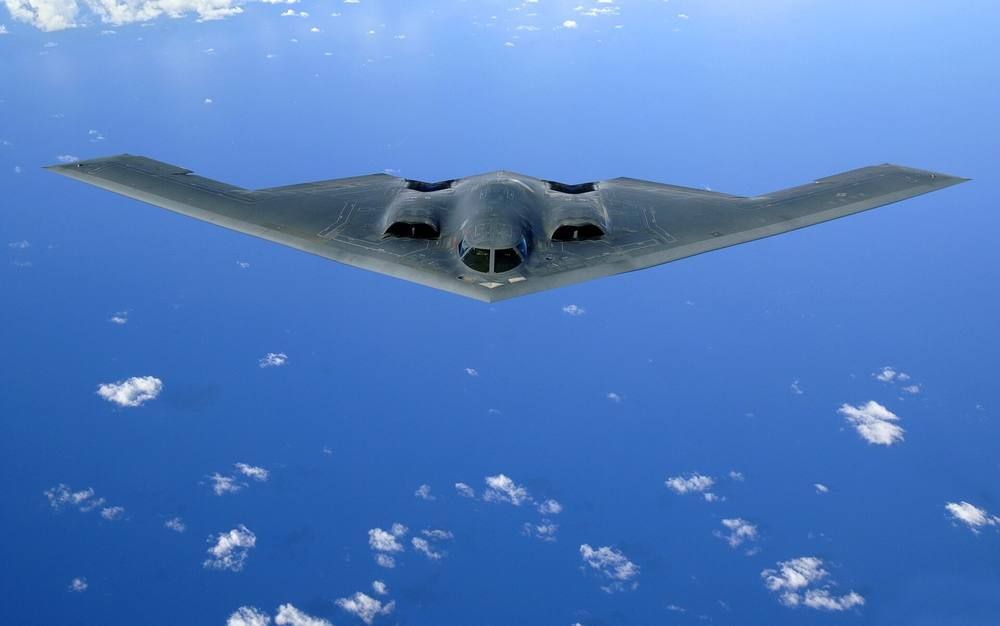
Known aircraft. The B-2 bomber is a triangular flying wing with a 172-foot wingspan and four jet engines, according to Northrop Grumman and the Air Force. The RQ-170 is another flying wing, with a wingspan of more than 65 feet according to an Army manual described by The War Zone. Both are far bigger than fifteen feet. A classified small tailless drone is not impossible. That is exactly what an investigation could check, by asking the owners of nearby airspace, and a public memo cannot.

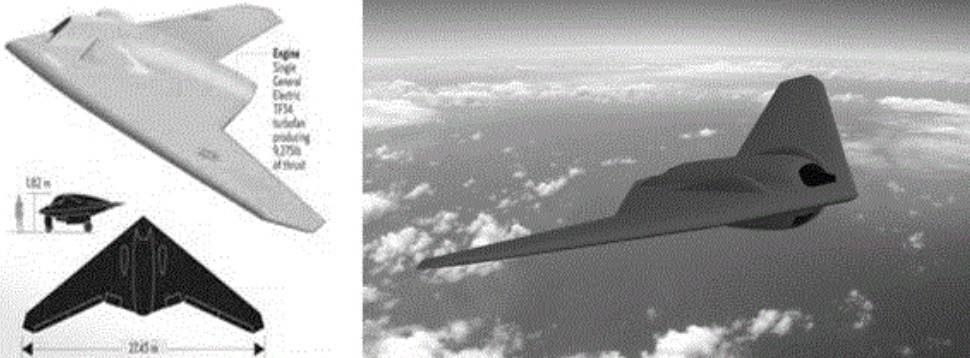

Where do these explanations strain? On the details the witnesses stressed: the absolute silence, the perfectly fixed orientation and the instant stop. Those are the claims, and they are the kind that instruments can confirm and memory cannot.
§ 8What a real investigation would look like
The method is not mysterious. It starts with raw data: a calibrated radar record from any radar covering the area, with the receiver settings, and raw thermal and optical recordings with metadata from more than one angle, so that position can be triangulated rather than estimated. Time stamps are checked. Then comes deconfliction. Every known flight, drone operator and test range nearby is asked about that time and place, and the answers are recorded. For the drone hypothesis, radio-frequency logs would show control links, and the drone detection systems at many secure sites would have a record. For the sound argument, someone measures how far a known small drone can be heard from that hilltop on a similar evening. For the size argument, someone places an object of known size at a known range and has witnesses estimate it. For the timing conflict, someone asks the witnesses and checks the logs.
None of that is in these documents. According to NHI Anomalous's reading of the release index, a second night and supporting analytic material exist and were not released. That reading could not be checked against the index on war.gov, which was blocked. If it is accurate, it is the most interesting thing in the release, and it is the material to request first. Then independent analysts with no stake in the answer need to see it. Loeb's call for better sensors at the locations is a reasonable forward-looking version of the same idea, though a documents-first review is cheaper and faster.
§ 9What the documents show, and what would settle it
For most of seventy-five years, people who reported things like this were laughed at, ignored or quietly studied. Belgium took a wave seriously in 1990 and came away with unresolved radar, a debunked photograph and a general saying "exceptional." Arizona laughed in 1997. In 2026 the government itself puts a witness memo on a website. That is a real change in how the subject is treated.
What the documents show is modest. Two or three trained observers reported a small black triangular object that climbed, perhaps held position, and left, silently, at dusk. Their two written accounts agree on shape, size range, direction and silence, and disagree on time, duration, whether there was a hover, and what to call it. No instrument measured its speed or size. Nobody has identified it, and neither document claims to. A drone is the first explanation, and the witnesses say they have reasons to doubt it. The Heathrow case is separate: a likely drone, a very close pass, and a board that could not identify the object.
What would settle it is data: calibrated radar, multi-sensor recordings, radio-frequency logs, deconfliction with known aircraft, and independent analysis, with the reasoning published. Until then the defensible position is that something was seen, nobody knows what, and the paper in hand is too thin to say more.
Watch & Listen
Hear this entry read aloud. Coming soon — the channels are not live yet.
Sources
Primary documents and agency pages
- Department of War, UFO/UAP release page (blocks automated access)
- Department of War, seventh PURSUE release, October 23, 2026 (blocks automated access)
- AARO Memorandum for Record, DOW-UAP-D176 (original on war.gov; blocks automated access)
- AARO Memorandum for Record, D176 (public mirror read; SHA-256 9c093e09...8c31 matches the mirror's listing)
- FBI FD-302, FBI-UAP-D043 (original on war.gov; blocks automated access)
- FBI FD-302, D043 (public mirror read; SHA-256 0c7430d1...6298 matches the mirror's listing)
- UK Airprox Board, Airprox report 2026127
- UK Airprox Board, 2026 reports index
- UK Airprox Board, copyright notice
- Congressional Research Service, "Defense Primer: Categories of Uncrewed Aircraft Systems"
- U.S. Army, "Fort Benning prepares Soldiers to fly, fight with drones" (Group 1 definition; blocks automated access)
Release trackers and mirrors
- UAP.GLOBAL, PURSUE Release 07 listing
- UAP Ledger, Release 7 manifest
- UAP Ledger, D176 extracted text
- UAP Ledger, FBI D043 page
- NHI Anomalous, Release 07 black triangle
News and commentary
- Scientific American, "Strange triangular craft reported in new U.S. government UFO release," October 23, 2026
- Axios, "Strange, flying 'black triangle' cited in new UFO documents," October 23, 2026 (blocks automated access)
- Fox News, Pentagon UFO files detail agents' sighting of silent triangular object
- Avi Loeb, "Comments on the Seventh Pentagon UAP File Release" (Medium; transcript of the NewsNation interview; blocks automated access)
- Metro, BA plane narrowly misses drone "the size of four toasters"
- DroneXL, British Airways 777 "four toasters" airprox
- The Aviation Hub, British Airways 777 mystery object near Heathrow
Reference pages (cross-reference only)
- Grokipedia, Black triangle (UFO)
- Grokipedia, Belgian UFO wave
- Grokipedia, Phoenix Lights
- Grokipedia, Lockheed Martin RQ-170 Sentinel
- Wikipedia, Black triangle (UFO)
- Wikipedia, Belgian UFO wave
- Wikipedia, Phoenix Lights
- Wikipedia, Northrop Grumman B-2 Spirit
- Wikipedia, Lockheed Martin RQ-170 Sentinel
Earlier reporting used for the Belgium and Phoenix summaries
- National Press Club event transcript, November 12, 2007
- Los Angeles Times, June 20, 1997, Symington press conference
- Deseret News, March 25, 2007, Symington says he saw a UFO
- Belgian Air Force, Major Lambrechts, "Report concerning the observation of UFOs in the night from March 30 to March 31, 1990" (full report, as reproduced)
- RTBF, "Des ovnis en Belgique: les gendarmes face à l'inexpliqué, en 1989 dans la région d'Eupen"
- Skeptoid, "The Belgian UFO Wave" (skeptics' explanation of the radar locks)
- VRT NWS, "Belgian UFO picture was really a forgery," July 27, 2011
- Deseret News, July 26, 1997, "Flares, not UFOs, caused light show, military says"
- NBC News, "Former Ariz. governor boosts UFO claims," 2007
- HISTORY, "Huge, Hovering and Silent: The Mystery of 'Black Triangle' UFOs"
- Northrop Grumman, B-2 technical details (172-foot wingspan)
- U.S. Air Force, B-2 Spirit fact sheet (blocks automated access)
- The War Zone, "This U.S. Army Manual Has New Details About the RQ-170 Sentinel Drone"
Images used (credits are also under each image)
- FBI-UAP-D043 and DOW-UAP-D176 pages: U.S. government works, public domain; see links above.
- Wikimedia Commons: U.S. Department of Defense and U.S. Air Force photographs (public domain); individual file pages are linked in each image credit.