The Weird
Beneath Giza: What Is Confirmed and What Is Only Claimed About Hidden Structures
By Darrell Wallen
Would you prefer to listen?
§ 1Where things stand
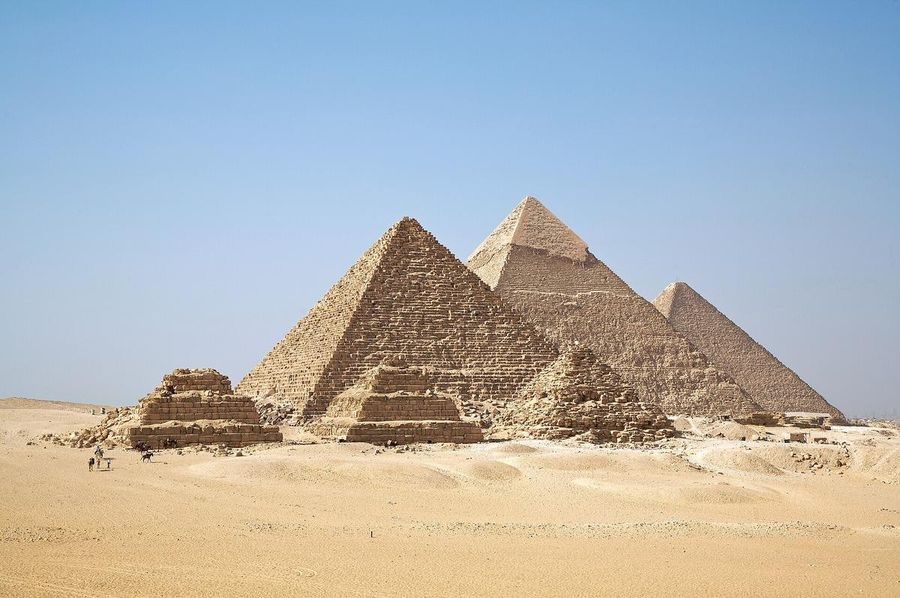
As of October 27, 2026, no hidden city has been found beneath the Pyramids of Giza. A claim made in March 2025, that satellite radar had revealed eight deep shafts and two giant cube-shaped structures under the Pyramid of Khafre, has not been published in a peer-reviewed journal and has not been independently confirmed. It has been rejected by Zahi Hawass, Egypt's former antiquities minister, and by radar specialists and Egyptologists in several countries.
In August 2026 the journal that published the same team's earlier paper on the Great Pyramid retracted it, citing serious methodological flaws and statistical errors. The team disagrees with the retraction. The Khafre claims were never part of that paper, so the retraction does not rule them in or out. It does remove the only peer-reviewed footing the claims had.
That is the news. It is only half the story, because some things really have been found in and under the Giza pyramids. Three categories need to be kept apart here. CONFIRMED means found by direct exploration, or by more than one independent method and reported in a peer-reviewed journal. CLAIMED means asserted by its proponents but not independently verified. LEGEND means a tradition with no documented physical evidence behind it.

§ 2The claim: March 2025
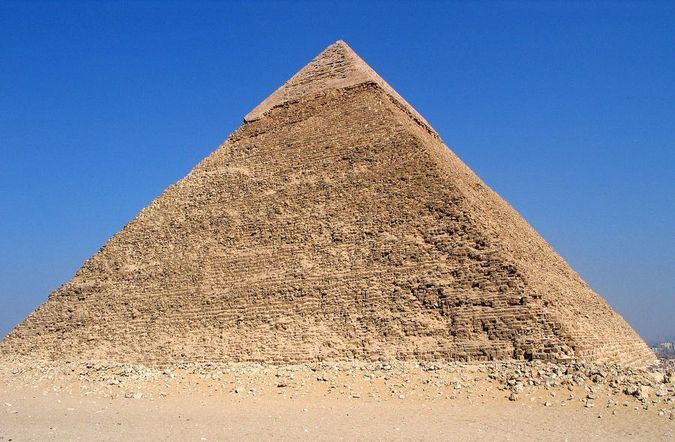
The claim comes from a small Italian-led group that calls itself the Khafre Project. Its best-known names are Corrado Malanga, an organic chemist at the University of Pisa, and Filippo Biondi, a telecommunications engineer. Retraction Watch reports that Biondi was a visiting professor at the University of Strathclyde in Scotland when the earlier paper was published. AFP reported that these two and a third figure, Armando Mei, have no background in Egyptology or archaeology.
The group presented its results in March 2025. Snopes traces an advertised conference in Bologna, Italy, to March 15. AFP reports that the trio held press conferences on YouTube on March 22 and 23. The material described five identical structures near the base of the Khafre pyramid, linked by pathways. Beneath them, it said, were eight cylindrical shafts, hollow and surrounded by a spiral descent, dropping 648 meters.
National Geographic reported that the shafts were said to connect to two cube-shaped structures 90 meters on a side, that the team dated the complex to roughly 38,000 years ago, and that the structures were placed two kilometers down. Figures vary between accounts.
Malanga described the picture this way at the press conference, in words Retraction Watch quoted: "It's like having two giant underground halls or cavities, each fed into by four spiral-wrapped shafts from above." That is how a radar story became, online, an "underground city."
The story spread fast. National Geographic reported that it was picked up by Infowars, Joe Rogan and Piers Morgan. Newsweek reported that the YouTube creator MrBeast offered to help explore the pyramids.
Status: CLAIMED. No excavation, drilling or independent survey has verified any of it.
§ 3How the method is supposed to work
Synthetic aperture radar, or SAR, is a satellite technique. A spacecraft sends radar pulses toward the ground and records the echoes to build an image of the surface. It is excellent for mapping terrain, tracking ground movement and spotting features on the surface. It is not a tool for looking hundreds of meters into solid limestone.
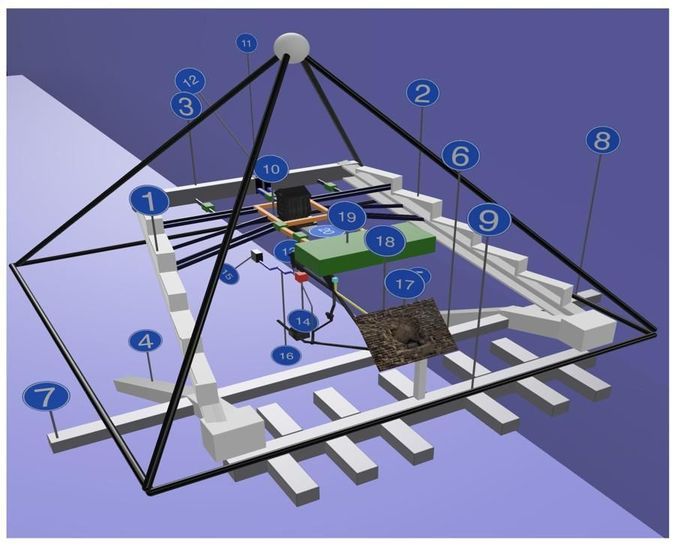
The team knows this. The abstract of its 2022 paper opens by saying that, because of the "poor penetrating action of electromagnetic waves inside solid bodies," the ability to observe inside such targets is precluded. Its answer is a method it calls Doppler tomography. The idea is that a huge structure like a pyramid vibrates very slightly in response to wind, the city of Cairo and background seismic activity. The satellite's radar records those tiny motions. Software then treats them as sound and turns them into a three-dimensional picture of what lies inside and below. The 2022 paper used images from the Italian COSMO-SkyMed satellites.
The paper also proposed that the Great Pyramid was ringed by a basin of Nile water and that its rooms were flooded at times to work as a giant acoustic filter. Its reference list includes Graham Hancock's Fingerprints of the Gods.
The authors did add a caution. They wrote that only confirmation on the field could validate their hypothesis, and they asked the Egyptian authorities to begin excavation and drilling. No drilling has happened.
The 2022 paper also pulls in two directions on the one internal feature that independent instruments had already confirmed. A section titled "Big Void" lists a large structure among the team's findings. Yet the discussion says that no trace of the big void identified by muon measurements was, in the authors' words, "in our hands detected by SAR."
§ 4The pushback
The reaction from specialists was fast and mostly blunt. Hawass issued a statement on March 26, 2025. As AFP quoted it, he called the rumors "nothing but fabrications propagated by individuals with no expertise in ancient Egyptian civilization or the history of the pyramids." He added: "There is no scientific evidence to support these assertions, and no archaeological missions are currently working inside the Pyramid of Khafre." Newsweek and National Geographic both report that Hawass said the Supreme Council of Antiquities had not granted the team permission.
Lawrence Conyers, a University of Denver professor emeritus who specializes in radar archaeology, told AFP: "Radar waves gradually attenuate in the ground. It is impossible to reach such a depth with this technique." In 2026 he went further with Retraction Watch. He said it is physically impossible for SAR to penetrate a pyramid, reflect off internal structures and return to the satellite, and he called the vibration explanation technically unsound. "I don't care what magical properties you are using, it just doesn't work," he said.
Sarah Parcak, a satellite archaeologist at the University of Alabama at Birmingham, was quoted by National Geographic: "SAR data can't see through rock, period." Salima Ikram, an Egyptologist at the American University in Cairo, told Decrypt there was "no peer-reviewed paper or raw data to back this up." She added that Egyptian authorities confirmed they had not granted the group permission to work at the site.
The archaeologist Flint Dibble made two practical points, as reported by National Geographic. SAR, he and the public archaeologist Milo Rossi have explained, only detects up to about two meters underground in similar conditions. And a 2019 study of the Giza water table, which he cited, puts the groundwater only a few dozen meters below the plateau. If megastructures sat two kilometers down, he said, they would always have been part of an underwater city. Think Aquaman's Atlantis, in the article's words, not Amsterdam. Dibble also joked, as National Geographic recounts, that one reconstruction looked like the reactor room from the film Total Recall.
Snopes rated the viral claim False on March 21, 2025. It noted that one widely shared cross-section of the supposed structures scored a 99.9 percent chance of being AI-generated on the Hive Moderation detector. AFP published its own fact check on April 23, 2025.
The team has not backed down. Biondi told AFP in an April 22, 2025 email: "The term impossible does not apply when objective evidence emerges." He added that the satellite data "indicate the presence of large artificial structures beneath the Giza Plateau, structures that appear to belong to an unknown civilization referenced in ancient myths worldwide." The second statement is an interpretation, not a measurement.
§ 5The retraction
In October 2022 Biondi and Malanga published a paper in the MDPI journal Remote Sensing, titled "Synthetic Aperture Radar Doppler Tomography Reveals Details of Undiscovered High-Resolution Internal Structure of the Great Pyramid of Giza." It listed 20 structures inside and beneath the Great Pyramid, including ramps, corridors and rooms. Among its other claims was that all three Giza pyramids have eight sides, not four.
On August 10, 2026, the journal retracted it. According to Retraction Watch, a reader brought concerns to the editorial office, and the editors' investigation "confirmed serious methodological flaws and statistical errors that were deemed to undermine the scientific conclusions of the article." Newsweek, quoting the notice, reports that it also called the findings and conclusions "not reliable." The notice did not allege fabrication or misconduct. It records that the authors disagree with the decision.
Two points need to be kept straight. The retraction concerns the 2022 Great Pyramid paper, not the Khafre claims, which were never submitted to that journal. And a retraction does not prove that nothing is down there. It means the journal no longer stands behind what the paper claims for its method.
After the retraction, Biondi shared a segment from the History Channel series The UnXplained on August 25, according to Newsweek. He also shared a team video saying technical plans for noninvasive field measurements and applications for excavation permits had been sent to Egypt's Ministry of Tourism and Antiquities on August 22. Newsweek notes the announcement did not say permission had been granted. As of late October 2026 I found no report that any permit was approved.
Status: the retraction is CONFIRMED. The Khafre shafts and cubes remain CLAIMED.
§ 6What independent checks show
Because the method was described in public papers and a patent, other people have tried to rebuild it. These efforts are not peer reviewed and should be read with that in mind.
A preprint on Zenodo by Hassan Foreman, posted in its fourth version on August 14, 2026, rebuilds the method from the team's papers and its lapsed patent. It runs the method on free radar scenes from two commercial satellite operators, Umbra and Capella, with control tests the original lacked. The preprint reports that the patent's key step is, by its own wording, a discrete Fourier transform, which returns structured output from any input. It says the reported depths follow from an investigation frequency of about 22 kilohertz that it calls physically impossible, and that a faithful reproduction yields a confident but surface-pinned artifact that matches no known structure.
The preprint also contains two withdrawals of its own. Version 4 pulls a headline statistic from earlier versions. It also pulls the claim that the Giza shafts and chambers are the rendered geometry of this artifact. What remains, in the author's words, is narrower: the source documents no part of its visualization pipeline, so the published three-dimensional figures cannot be reproduced even in principle.
A second write-up, posted on the Italian site Accadrà di nuovo and last updated on September 25, 2026, tested the method on the Great Pyramid's known chambers using open Capella data. The author says the rules of the test were sealed on September 23, before the images were opened. Of seven tests, four failed, and in the other three the calculation produced no value at the chamber. No known chamber showed up, including the King's Chamber used to calibrate the scale. The page says plainly that this does not mean there is nothing under Giza, only that the method, as rebuilt, does not see the chambers we already know about.
Neither has been through peer review, and both depend on rebuilding a method whose source code is not public. They are consistent with each other and with the specialist critiques. I found no independent replication that supports the Khafre claims.
Status: the independent reproduction attempts report failure. These are CLAIMED results too, with the caveats above.
§ 7What is confirmed: from Herodotus to bedrock
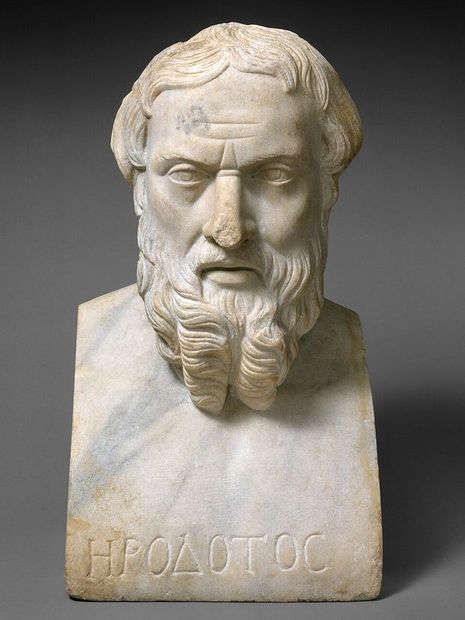
Speculation about hidden spaces below Giza is very old. National Geographic traces it back to Herodotus. The Greek historian, writing more than two thousand years after the pyramids went up, reported what the Egyptians told him about Khufu, whom he calls Cheops. The ten years of work, they said, went partly on "the underground chambers on the hill upon which the pyramids stand, which he caused to be made as sepulchral chambers for himself in an island, having conducted thither a channel from the Nile." That is the Macaulay translation.
Of Khafre's pyramid, Herodotus said something different. There "are no underground chambers beneath nor does a channel come from the Nile," he wrote. He added that he had measured it himself.

Herodotus was half right and half wrong. The Great Pyramid does have a chamber cut into the bedrock below it. NOVA describes an unfinished subterranean chamber about 90 feet, or 30 meters, below the surface of the plateau. Egyptologists believe it was the original burial chamber, abandoned when Khufu decided he wanted his burial chamber higher in the pyramid. The same NOVA page says Khafre's pyramid follows a similar pattern, with an unfinished subterranean burial chamber of its own. So Khafre does have a chamber cut into the rock. It is just very much smaller than anything on the Khafre Project's drawings.
Status: the unfinished chamber under the Great Pyramid is CONFIRMED. Herodotus's island and Nile channel are not documented in any source I read.
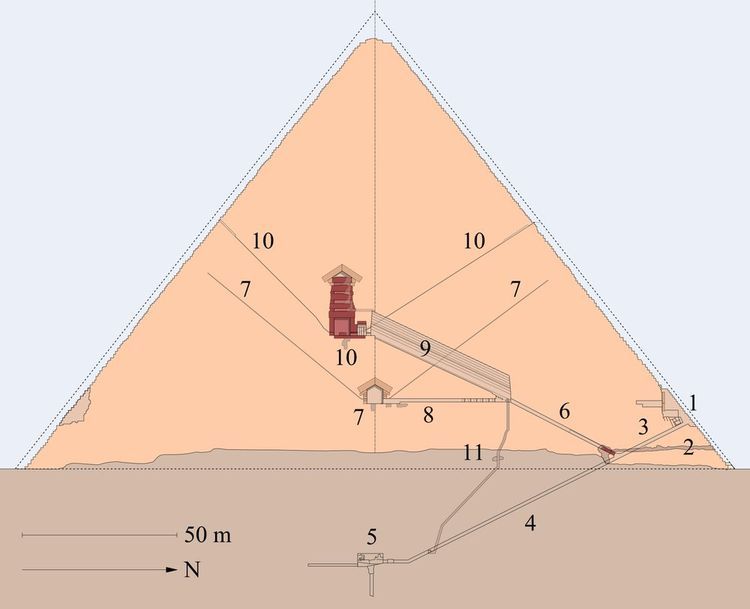

Khafre's pyramid was opened in modern times by Giovanni Belzoni, an Italian adventurer who reached the burial chamber on March 2, 1818, according to Nile Magazine. He found an empty sarcophagus, and Arabic writing indicating the pyramid had been opened around 1200 A.D. He also signed the wall, with the words "Discovered by G. Belzoni. 2. Mar. 1818," which can still be seen.
Other shafts around Giza are on the record. The Osiris Shaft is a deep burial shaft on the plateau that Hawass's team excavated and reported in a chapter titled "The Discovery of the Osiris Shaft at Giza." It is a fair example of how real hidden Giza turns out: a burial shaft, not a city.
The Giza Plateau Mapping Project, run by Mark Lehner and Ancient Egypt Research Associates, mapped the plateau's geology and terrain from 1984 to 1987, according to AERA. In 1988 it found the Lost City of the Pyramids, the settlement of the people who built the monuments. Smithsonian magazine tells an odd footnote. Lehner finished his undergraduate degree in Cairo with support from the foundation of Edgar Cayce, the clairvoyant, and then grew skeptical of the hall of records Cayce described.
§ 8Earlier scans, and earlier hype
Instruments have been probing the plateau for decades. In 1977, Smithsonian reports, Stanford Research Institute scientists used remote-sensing equipment on the bedrock beneath the Sphinx and found only the cracks and fissures expected of ordinary limestone.
In 1987, the Christian Science Monitor reported that Japanese scientists from Waseda University had found a cavity about six feet east of the Sphinx using an electromagnetic scanner, and two cavities behind the walls of what is called the Queen's Chamber in the Great Pyramid. The report is a useful reality check. The scanner's range was only 10 meters each way, and inside the Great Pyramid, because of humidity, the waves penetrated only about five meters. The 1987 equipment saw five meters. The 2025 claim is for 648.
The geologist Robert Schoch described seismic work around the Sphinx, published with Thomas Dobecki in the journal Geoarchaeology in 1992. On his own website, Schoch says the survey found evidence of a cavity or chamber under the Sphinx's left paw, plus lesser, previously known cavities nearby. He notes that some people suggested the cavity might be a "Hall of Records." Those are geophysical anomalies, not excavated rooms.
Status: the Waseda and seismic anomalies were REPORTED by instruments. They have not become documented chambers.
§ 9The muon era: ScanPyramids
The strongest evidence for hidden spaces inside Giza's pyramids comes from a very different tool. Muon radiography uses cosmic-ray muons, subatomic particles that pass through stone but are slightly absorbed along the way. Detectors placed inside or beside a monument record how many arrive from each direction. A void shows up as a patch of extra muons.
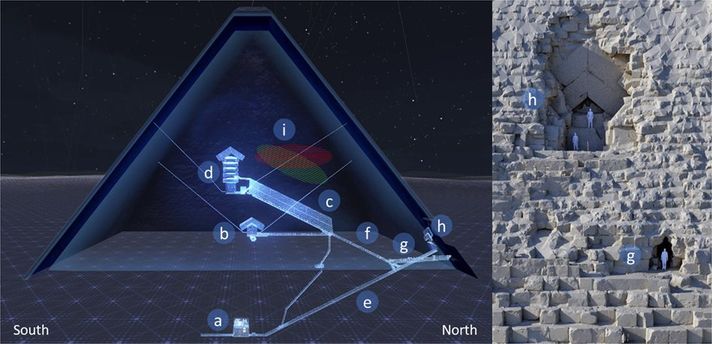
In 2017 the ScanPyramids team reported in the journal Nature the discovery of a large void above the Grand Gallery of the Great Pyramid, with a cross-section similar to the gallery's and a minimum length of 30 meters. The paper said it was the first major inner structure found in the Great Pyramid since the nineteenth century. The void, named ScanPyramids' Big Void, was first seen with nuclear emulsion films in the Queen's Chamber, then confirmed with two other kinds of detector. In the authors' words, it was detected "with high confidence by three different muon detection technologies and three independent analyses." The paper said there is currently no information about the void's intended purpose.
On March 2, 2023, a follow-up in Nature Communications examined a corridor-shaped structure behind the Chevron stones on the pyramid's north face. Earlier work had put its length at at least five meters. New measurements with nuclear emulsion films from Nagoya University and gaseous detectors from the French CEA found a structure about nine meters long, with a section of about two meters by two meters. Later papers listed on the journal's page report confirming the corridor with other methods, in March and November 2025.
Status: the Big Void and the North Face Corridor are CONFIRMED by independent methods. Their purpose is not known. Both are measured in meters, not in kilometers.
§ 10Legends: the Hall of Records and the rest
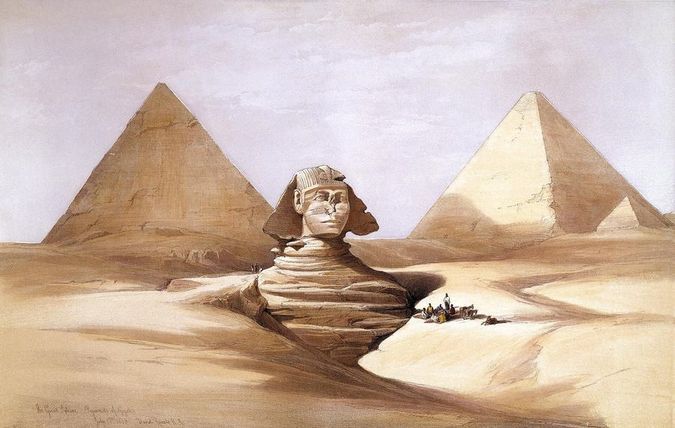
A different tradition places something under or inside the Sphinx. In 1935, according to the Christian Science Monitor, Edgar Cayce said in a trance that people from Atlantis put documents on their history in a Hall of Records in the Sphinx's paws, and that it would be opened in 1998. The Association for Research and Enlightenment, which preserves Cayce's readings, says they describe a record chamber reached by "a chamber or passage from the right forepaw." Schoch's survey, for what it is worth, put its cavity under the left one.
The idea fed into popular books, including Graham Hancock and Robert Bauval's The Message of the Sphinx. In 1997 the Christian Science Monitor reported that followers of the Atlantis theory accused Hawass of blocking them from investigating a door under the Great Pyramid that they said leads to the Sphinx's paws. Hawass called the believers "pyramidiots." He said: "Not a single object or piece of an object has been found at Giza that can be interpreted to come from a lost civilization."
1998 came and went. No Hall of Records has been documented. Status: LEGEND.
_by_David_Roberts,_RA.jpg)
§ 11What has happened since: 2025 and 2026
The Khafre claims have kept circulating. They reached the History Channel in August 2026, in an episode of The UnXplained narrated by William Shatner, according to Retraction Watch, which described the 2025 findings as not published or peer-reviewed. As of October 2026 I found no peer-reviewed paper, no reported permit and no field verification.
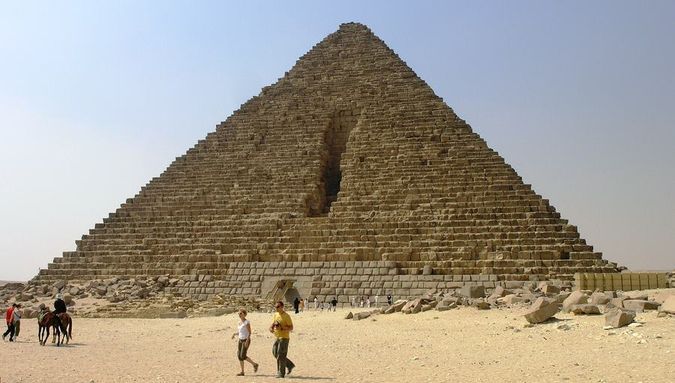
Meanwhile, the careful work continued. In 2026 researchers from Cairo University and the Technical University of Munich, working within ScanPyramids and, according to the release, in collaboration with and under the supervision of Egypt's Supreme Council of Antiquities and Ministry of Tourism and Antiquities, reported two air-filled voids behind the smooth eastern facade of the Menkaure pyramid. The paper lists Zahi Hawass among its authors. The team used ground-penetrating radar, ultrasound and electrical resistivity tomography. The voids sit 1.4 meters and 1.13 meters behind the outer wall, and the larger is about a meter high and 1.5 meters wide.
The finding supports a 2019 idea from the researcher Stijn van den Hoven that a second entrance might exist at that spot, where a four-meter-high, six-meter-wide section of granite blocks looks unusually smooth. Christian Grosse of TUM said the hypothesis of another entrance is "very plausible, and our results take us a big step closer to confirming it." The voids have not been opened. They are CONFIRMED as anomalies by several independent methods, and the entrance idea is a hypothesis.

There is one more item to watch. In November 2025 Hawass told the Sharjah International Book Fair that scanning had found a previously unknown 30-meter corridor inside Khufu's pyramid, according to a Jerusalem Post report based on Al Arabiya. He said its contents would be disclosed in 2026. As of October 27, 2026, I found no official announcement. The North Face Corridor measured in 2023 is about nine meters long, so it is not clear that the two are the same thing. This is a statement of intent, not a result.
§ 12The bottom line
Here is the line between what is known and what is not. Confirmed: the Great Pyramid and Khafre's pyramid each have an unfinished chamber cut into the bedrock. Confirmed: a large void above the Grand Gallery, a corridor behind the north face, and, in 2026, two small voids behind the Menkaure facade. Confirmed: the 2022 Great Pyramid radar paper was retracted on August 10, 2026. Claimed: eight shafts descending 648 meters, two large cubes, five structures near the Khafre base, and a depth of two kilometers. Legend: the Hall of Records.
The distinction matters because the real discoveries are quiet. They were made with particle detectors, ultrasound and ordinary radar, in some cases under the supervision of Egypt's antiquities authorities. They are meters deep, they were checked by more than one method, and they have been published. The claim of a 648-meter shaft was made at a press conference.
That does not close the case. The way to test the claim is the way the team itself asked for in 2022, with drilling and independent instruments on site. Until that happens, the giant structure beneath Khafre is a claim and not a finding. The ground at Giza has surprised people for a very long time. It may do so again. It would help if the next surprise arrived with data attached.
Sources
- Retraction Watch, on the retraction of the Great Pyramid paper (Aug. 31, 2026)
- Newsweek, on the retraction of the Great Pyramid study (2026)
- National Geographic, Candida Moss, on the claimed city beneath the pyramids (2025)
- AFP Fact Check (Apr. 23, 2025)
- Snopes fact check (Mar. 21, 2025)
- Decrypt, expert reaction to the Giza claims (2025)
- Jerusalem Post, on Zahi Hawass at the Sharjah International Book Fair (Nov. 2025)
- Biondi and Malanga, Remote Sensing 14(20), 5231 (2022), retracted Aug. 10, 2026
- ScanPyramids team, Nature (2017), the Big Void
- Procureur et al., Nature Communications (2023), the North Face Corridor
- ScienceDaily, Menkaure voids (Apr. 23, 2026)
- Herodotus, The Histories, Project Gutenberg
- NOVA, Khufu's pyramid unfolded
- Nile Magazine, on Khafre's burial chamber (March 2015)
- Digital Giza, The Discovery of the Osiris Shaft at Giza
- Ancient Egypt Research Associates
- Smithsonian Magazine, on the Sphinx
- Christian Science Monitor (June 23, 1987)
- Christian Science Monitor (May 28, 1997)
- Robert Schoch, on the Sphinx
- Association for Research and Enlightenment, on Cayce's Hall of Records
- Foreman, independent reproduction preprint (Zenodo, v4, Aug. 14, 2026; not peer reviewed)
- Accadrà di nuovo, SAR verification write-up (not peer reviewed)
Image sources
- Giza pyramids aerial, hero (Ricardo Liberato, CC BY-SA 2.0)
- Pyramid of Khafre (Digr, public domain)
- Figure 22, 3-D reconstruction from the retracted 2022 paper (F. Biondi and C. Malanga, Remote Sensing 14(20), 5231, CC BY 4.0)
- Marble bust of Herodotus (Metropolitan Museum of Art, CC0)
- Great Pyramid south-north diagram (F l a n k e r, CC BY-SA 3.0)
- Great Pyramid cut-away and North Face Chevron view (Procureur et al., Nature Communications 2023, CC BY 4.0)
- The Great Sphinx and the Pyramids of Gizeh (David Roberts, 1839, public domain)
- Pyramid of Menkaure (Daniel Mayer, CC BY-SA 4.0)

