Space
Webb Finds Signs of a Reflective Atmosphere on the Lava World TOI-561 b
By Darrell Wallen
Would you prefer to listen?
§ 1The news
Astronomers using the James Webb Space Telescope report that a lava world called TOI-561 b appears to be wrapped in a substantial atmosphere, and that the atmosphere reflects roughly three-quarters of the starlight that falls on it. The planet is about 280 light-years from Earth. The university news releases describe its surface as an ocean of molten rock. By the usual expectations of planetary science, a small planet this close to its star should have lost any atmosphere billions of years ago.
The new result comes from a continuous 37-hour observation. The University of Birmingham published a news release about it on October 27, 2026, and the University of Waterloo published its own. The scientific paper is titled "A Highly Reflective Atmosphere on the Lava World TOI-561 b Revealed by JWST/NIRSpec Phase Curve," and it appears in The Astronomical Journal, volume 172, issue 4. The journal's record lists the publication date as September 29, 2026. A preprint was posted to the arXiv site on August 21, 2026, and revised on August 28. The first author is Samuel Boucher, and the corresponding author is Lisa Dang of the University of Waterloo. Eighteen authors are listed in all.
Here is the short version, with the confirmed parts and the unconfirmed parts kept separate. What is confirmed is the observation and the measurements that came out of it: the planet's sunlit side is far cooler than a bare dark rock would be, and its night side is warmer than a bare rock would be. What the authors conclude, and what peer review accepted, is that the best explanation is a global atmosphere with high reflectivity. What is not confirmed is what that atmosphere is made of, and whether the leading explanation for the shine, clouds of silicate minerals, is actually right. Those clouds come out of computer models. Nobody has seen them.
The word "sunscreen" appears in the Birmingham release. It is a headline metaphor for the idea that reflective clouds could keep the planet cooler than it would otherwise be. It is not a technical term, and it does not mean the planet is protected in any sense a person would mean it.
§ 2A planet unlike most
TOI-561 b is an ultra-short-period planet. That is the astronomers' name for a small rocky world that circles its star in less than a day. TOI-561 b goes around once every 0.4465 days, which works out to about 10.7 hours. A year on this planet is shorter than a workday.
It is very close to its star. NASA's December 2025 release on this planet says it orbits at less than one million miles from the star, about one-fortieth of the distance between Mercury and the Sun. The new paper's orbital geometry puts the planet at about 2.7 stellar radii from the star's center. Using the paper's stellar temperature and that distance, my own arithmetic gives about 6.5 million watts of starlight per square meter at the planet. NASA's fact sheet lists the sunlight at Earth as 1,361 watts per square meter. So the planet receives something like 4,800 times the stellar energy that Earth does. The Space Telescope Science Institute, which writes Webb's news releases, describes a star so close that it spans a quarter of the planet's sky.
At that distance the planet is almost certainly tidally locked, with one side permanently facing the star, the way the Moon keeps one face toward Earth. The new paper treats it that way. That means a dayside that never sees night and a night side that never sees day.
The planet is a little larger than Earth. The paper uses a radius of about 1.42 Earth radii, a mass of about 2.24 Earth masses, and a bulk density of about 4.3 grams per cubic centimeter, give or take 0.4. NASA lists Earth's mean density at about 5.5. So the planet is less dense than an Earth-like mix of rock and iron would be, and that detail has been part of its story from the start.
The star is unusual too. The new paper calls TOI-561 a late G or early K dwarf, a little smaller and cooler than the Sun, with a radius of about 0.84 times the Sun's and a surface temperature of about 5,370 kelvin. It is old. The paper gives an age of at least ten billion years. In NASA's release, Johanna Teske of the Carnegie Science Earth and Planets Laboratory described it as a "very old (twice as old as the Sun), iron-poor star in a region of the Milky Way known as the thick disk." The paper adds that the star is rich in alpha elements, and that this makes the planet's formation environment chemically distinct from the solar system's and from that of other ultra-short-period planets.
§ 3How the planet was found
TOI-561 was flagged by NASA's TESS survey spacecraft, and two independent teams published papers on the system in 2021. One was led by Gaia Lacedelli, in the Monthly Notices of the Royal Astronomical Society, using the HARPS-N spectrograph. The other was led by Lauren Weiss, the second paper in the TESS-Keck Survey series, in The Astronomical Journal, using the HIRES spectrograph at the Keck Observatory.
Both teams confirmed the ultra-short-period planet, now called TOI-561 b. They did not agree on its mass. The Weiss team found about 3.2 Earth masses, consistent with a rocky composition. The Lacedelli team found about 1.6 Earth masses and a density of about 3.0 grams per cubic centimeter, which made it the lowest-density planet of its kind known at that time. The Lacedelli paper described a system of four planets, with orbits of about 0.45, 10.8, 25.6 and 77 days.
More data narrowed the gap. A 2022 follow-up led by Lacedelli, adding observations from the CHEOPS space telescope and 62 new HARPS-N velocity measurements, gave planet b a density of about 3.8. The new Webb paper cites a mass of 2.24 Earth masses from a 2023 study led by Brinkman, and a radius from a 2023 study of CHEOPS and TESS data led by Patel. Together they give the density of about 4.3 that the Webb team uses today. The point is that the estimates moved around between papers, and the low density is not as settled as a single number makes it sound.
I mention this history because the low density is part of why Webb looked at the planet at all. A planet that is less dense than its composition would suggest might have an unusual interior. Or it might carry a thick envelope of gas that makes it look bigger than the rock beneath it.
§ 4The first Webb result, December 2025
The observation behind both the new result and the earlier one was made with Webb's Near-Infrared Spectrograph, called NIRSpec, from May 1 to May 3, 2024. It was part of a program numbered 3860, titled "Phase Curve Observations of TOI-561 b To Study Atmosphere-Interior Exchange."
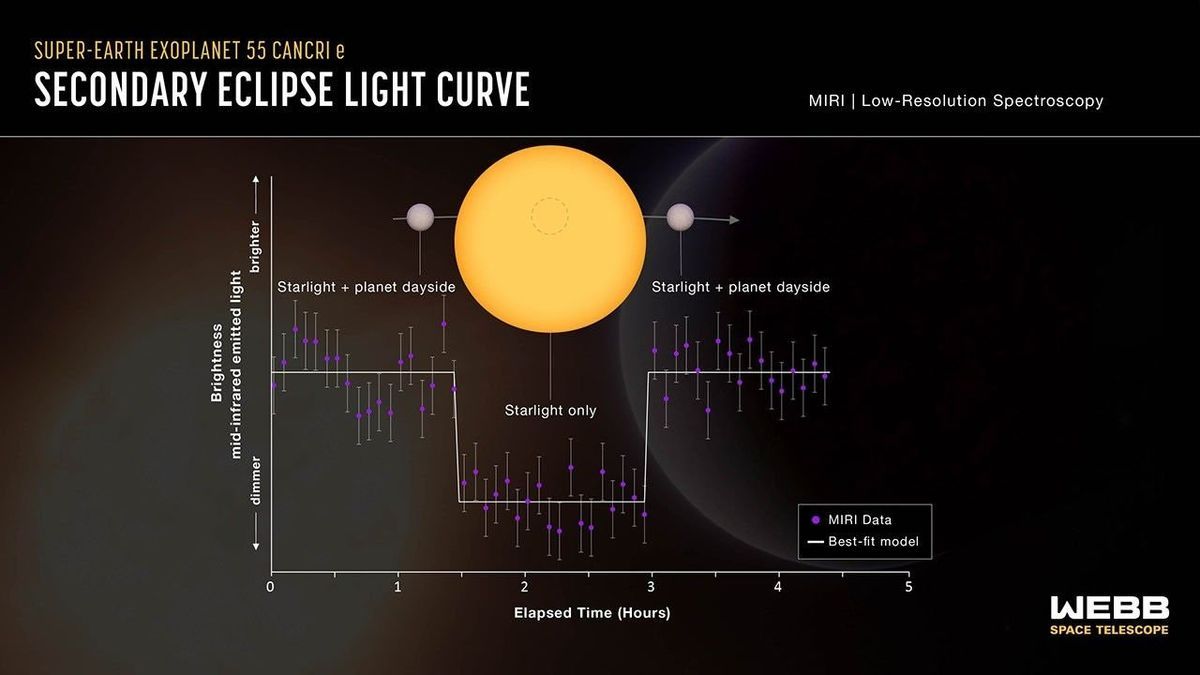
The first published analysis came out on December 11, 2025, in The Astrophysical Journal Letters, with Teske as lead author. It used only the four moments in the data when the planet passed behind the star, an event called a secondary eclipse. When the planet is hidden, the telescope sees only the star. When the planet is beside the star, the telescope sees both. Subtract one from the other, and what is left is the planet's own light, which for a tidally locked planet is mostly the glow of its hot dayside.
The result was a surprise. NASA's release says a bare rock with no atmosphere should have a dayside temperature approaching 4,900 degrees Fahrenheit, or 2,700 degrees Celsius. The data pointed to a dayside closer to 3,200 degrees Fahrenheit, or 1,800 degrees Celsius. That is still searingly hot, and it is far cooler than expected.
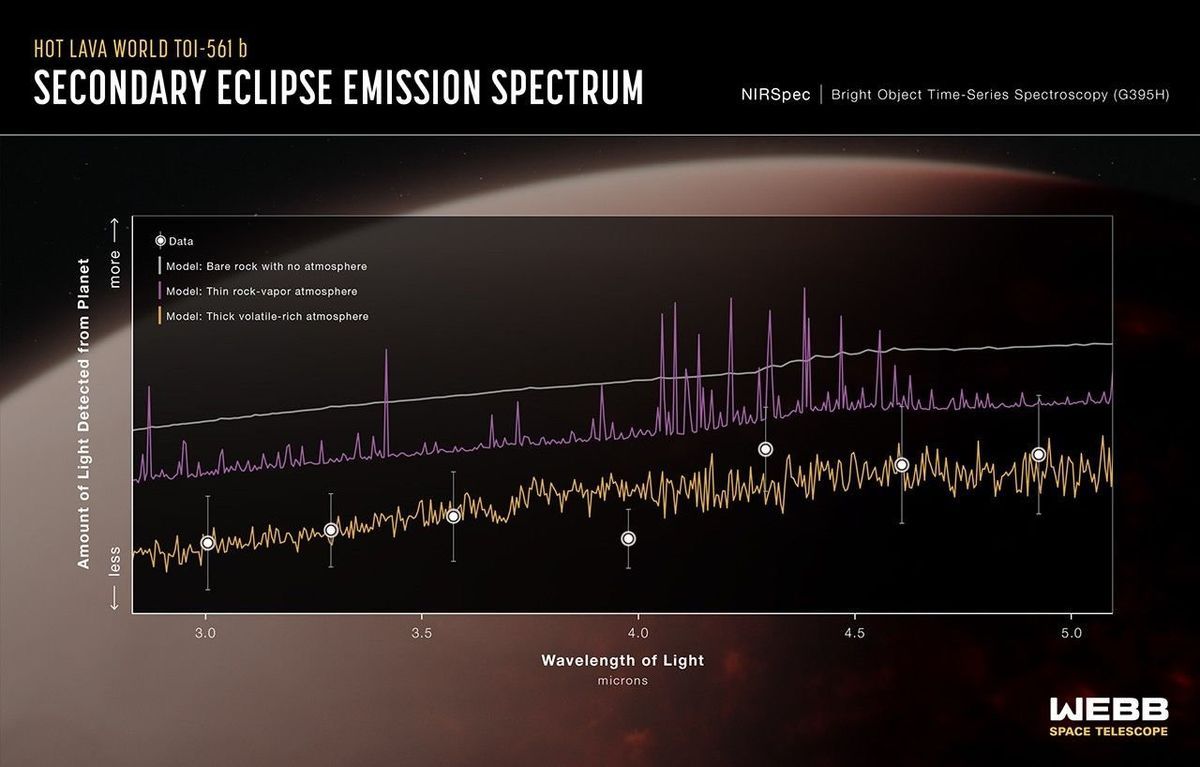
The team tested several explanations. A thin layer of rock vapor above the molten surface was clearly inconsistent with the data in their models. Thick atmospheres rich in gases such as water vapor fit much better. In NASA's release, Anjali Piette of the University of Birmingham said, "We really need a thick volatile-rich atmosphere to explain all the observations." Tim Lichtenberg of the University of Groningen described a back-and-forth exchange of gases between the magma ocean and the atmosphere, and said, "It's really like a wet lava ball."
The authors were careful about what they could not say. In the 2025 paper, their search for specific molecules in the spectrum found no statistical preference for any chemical feature, and the data looked close to a smooth blackbody curve. The case for an atmosphere rested on the overall coolness of the dayside, not on the fingerprint of a particular gas. The paper pointed out that the infrared range Webb used does not cover the peak of the planet's emission, so the exact way an atmosphere cools the planet matters. It also listed heat transport to the night side and reflective clouds as possible contributors.
That is where the new paper picks up.
§ 5What a phase curve is
A phase curve is a record of how the total light from a star and planet changes over the planet's orbit. A tidally locked planet shows us different faces as it goes around. We see mostly its night side just before it passes in front of the star, and mostly its dayside just before it passes behind. If the dayside is much brighter in the infrared than the night side, the combined light of the system rises and falls slightly with each orbit.
Those changes are tiny. In the new paper, the planet's dayside light comes to about 35 parts per million of the star's light in the shorter-wavelength detector and about 47 in the longer one. That is a few thousandths of one percent. Measuring it takes a stable instrument, a long watch, and careful removal of every other source of variation.
The long watch is what makes the difference. Webb's 37-hour stare covered four secondary eclipses and three transits, which are the moments the planet passes in front of the star. The paper describes it as covering four full orbits, and the releases say nearly four. By simple arithmetic, 37 hours is about three and a half orbits of 10.7 hours. Either way, it is long enough to include the night side and a continuous look at how the brightness changes around the planet, which the eclipse-only analysis could not provide.
A phase curve gives astronomers two things an eclipse alone does not. It shows the contrast between day and night, which tells how much heat the planet moves around. And it shows whether the brightest spot is shifted away from the point directly under the star, which would be a sign of winds carrying heat.
The new paper also handles a problem the first one did not. Stars are not perfectly steady. The surface of a Sun-like star churns with convection cells, a process called granulation, and that churning produces small random changes in brightness. For a planet signal of a few dozen parts per million, the flicker matters. The team modeled it with a statistical tool called a Gaussian process and fitted the star's flicker, the planet's phase curve and the eclipses all at once. They found granulation amplitudes of about 55 to 62 parts per million, on timescales of 22 to 25 minutes, which the paper says is consistent with the order of magnitude expected. The authors say the 37-hour baseline is long enough to separate the star's noise from the planet's signal, and that the resulting dayside spectrum is more robust against stellar variability and consistent with the earlier eclipse-only analysis.
§ 6What the data show
The combined fit across both of NIRSpec's detectors gives a dayside temperature of about 2,050 kelvin, with an uncertainty of a couple of hundred kelvin either way. That is roughly 3,200 degrees Fahrenheit. It gives a night-side temperature of about 1,090 kelvin, or roughly 1,500 degrees Fahrenheit, with a larger uncertainty on the low side. Neither number is a thermometer reading. They are brightness temperatures, worked out from infrared light in a slice of the spectrum between about three and five micrometers.
According to the paper, a bare, dark rock with no way to move heat to its night side would have a dayside near 3,200 kelvin, roughly 5,300 degrees Fahrenheit. The observed dayside is more than 1,100 kelvin cooler than that. And the night side is not cold. A bare rock would give off almost nothing there. Here there is a clear glow.
From those temperatures, the team works out two quantities. One is the Bond albedo, the fraction of all incoming starlight that a planet reflects back into space. They find about 0.74, with an uncertainty of about a tenth. That is where the figure of roughly three-quarters comes from. The releases say this is comparable to Venus, and NASA's fact sheet lists Venus's Bond albedo as 0.77. Venus is wrapped in thick, bright clouds. Earth's, by the same fact sheet, is about 0.29.
The other quantity is the heat redistribution efficiency, which measures how well the atmosphere carries heat from the dayside around to the night side. The paper finds about 0.18, with a wide uncertainty, and calls the result moderate heat transfer. The authors write that the temperatures, the high albedo and the moderate heat transfer together are "collectively inconsistent with a bare rock, and most naturally explained by a global atmosphere driving large-scale circulation."
Now the caveats, because there are real ones and the paper states them. The first is that all of this comes from a limited slice of infrared light. The Bond albedo is inferred from the planet's infrared emission and from comparison with climate models. Nobody has measured the planet's reflectivity in visible light.
The second is that the two NIRSpec detectors do not fully agree. In the shorter-wavelength detector, the night side is so faint that the team reports only an upper limit. In the longer-wavelength detector, the night side is clearly detected. The detectors also differ on where the hottest spot sits. The paper says the westward hot-spot offset in the longer-wavelength detector cannot be explained by the team's climate models, although the offsets are consistent with zero within three standard deviations. The discrepancy, the authors write, is "still somewhat mysterious." They say it could come from detector effects, from stellar variation that changes with wavelength, or, in their words, "(more excitingly)" from clouds or composition that change with wavelength. They also say they cannot rule out that residual detector systematics in the shorter-wavelength channel are responsible for part or all of the odd night-side flux there.
So the detection is real, the interpretation is reasonable, and the details are still uncertain.
§ 7Why a bare rock does not fit
To test the idea, the team ran a general circulation model, a computer simulation of how winds and heat move through an atmosphere. They used a code called Isca, set up with the planet's mass, radius, orbit and starlight. They tried three sample atmospheres: pure water vapor, an even mix of water vapor and carbon dioxide, and almost pure oxygen. These were illustrative examples, not a survey of every possibility.
A bare rock did not fit. Its simulated phase curve had a much larger amplitude than the observed one. To match the observations, the models needed a high albedo, about 0.6 in the best-matching runs shown. They also found that an atmosphere with a surface pressure of about one to ten bars was needed to come close to the observed curves. For scale, one bar is roughly the air pressure at sea level on Earth.
This matters because laboratory measurements indicate that the surfaces of lava planets are poor reflectors. So the shine cannot come from the lava itself. The paper says radiative-convective models show that atmospheres outgassed from magma oceans can reach high albedos through scattering, by gases or by clouds. In other words, the brightness has to come from something above the lava.
§ 8The case for silicate clouds
The authors then asked whether clouds could form at all. The dayside is hot enough to vaporize rock. In the atmosphere, that vapor can cool and condense, much as water vapor does on Earth, except that here the material is mineral.
They used a chemistry code called FastChem Cond, coupled to a code for the gases a magma ocean releases, to calculate what would condense. They did this for a one-bar water-vapor atmosphere as an illustrative case. Several candidates appeared on the dayside, including silicon dioxide, the compound in quartz and sand, and magnesium silicate. The University of Waterloo release describes these as the same family of compounds that make up quartz and sand. The paper notes that the light-scattering strength of silicon dioxide in the NIRSpec range is very high.
Then they tested whether those clouds could account for the albedo. Starting from the hottest, most conservative climate-model run, in which the planet has no albedo at all, they marked where the air is cool enough for silicon dioxide to condense and where starlight actually arrives. That left clouds near the dayside's morning edge. Counting only those, the albedo they contributed was about 0.22 to 0.24. That is well short of 0.74. But the authors say it shows that even in the least favorable case, clouds can form. They add that clouds would cool the planet, which could trigger more cloud formation and raise the albedo further.
The paper is careful about its wording. It calls the high albedo "suggestive of reflective clouds." The abstract says silicate clouds "can form on the dayside near the terminator and explain the observed albedo." The press releases use the words "may," "could" and "suggest." The paper also says the dominant cloud material depends on the atmosphere's makeup, which is unknown. It cites other recent models in which titanium dioxide is a major cloud component in oxygen-rich atmospheres. Silicate clouds are the leading interpretation. They are not proven.
The paper also points to a possible parallel. The hot Neptune LTT 9779 b has a high reflectivity that other studies attribute to reflective silicate clouds. Those clouds reduce the starlight the planet absorbs and so limit how fast its atmosphere escapes. The authors suggest reflective clouds could be part of a similar feedback on TOI-561 b, helping it retain its atmosphere. They say exploring that idea in detail is beyond the scope of the paper.
§ 9What the atmosphere is made of
This is the open question, and the releases are frank about it. The Birmingham and Waterloo releases say the atmosphere could be a dense blanket of carbon dioxide, like a much hotter version of Venus. Or it could be rich in sulfur dioxide, the gas that streams from the volcanoes of Jupiter's moon Io. NASA describes Io as the most volcanically active world in the solar system. Dang says the next big question is whether the atmosphere resembles Venus or an extreme version of Io.
Those two are possibilities named in the news releases. The paper's own modeling used water, a water and carbon dioxide mix, and oxygen as sample compositions. Its introduction lists water, carbon monoxide, carbon dioxide, nitrogen and sulfur dioxide as volatile gases such planets might host. The paper does not identify the gas.
There is one tentative hint. In the updated dayside spectrum, the authors see a feature between four and four and a half micrometers that could be consistent with carbon dioxide emission, if the dayside atmosphere gets hotter with altitude. They call it tentative. In the 2025 paper, a model containing carbon dioxide fit less well than the water-based ones. So whether the planet's air is more like Venus, like Io, or like something else entirely is wide open.
§ 10Why this matters
The puzzle is how the planet could keep an atmosphere at all. Atmospheric escape theory says a small planet bathed in this much radiation should lose its volatile gases to space. Astronomers describe a rough dividing line, sometimes called the cosmic shoreline, between planets that keep atmospheres and planets that do not. The 2025 paper said that TOI-561 b, given its high irradiation and low escape velocity, is in strong conflict with that line.
Piette said in the Birmingham release, "Our discovery challenges current theories. We would expect a heavily irradiated rocky planet like TOI-561 b to have lost its atmosphere billions of years ago. Instead, the evidence suggests it still has a significant atmosphere today." She added that this raises the question of whether the planet started with an unusually large supply of gases, or whether its ocean of molten rock acts as a planet-wide volcano that constantly feeds the atmosphere.
The new paper lists four possible explanations, and says the answer may be a combination of them. The planet may have formed with an enormous amount of volatiles, starting out as a volatile-rich sub-Neptune. Escape of heavier secondary atmospheres may be much less efficient than escape of hydrogen and helium. The planet may have formed much farther out and moved to its current orbit late, avoiding the worst of the early radiation from its star. Or the original volatiles may have been sequestered in the interior and outgassed later. The authors say they will test these in upcoming work on the coupled evolution of the interior and atmosphere.
§ 11Other lava worlds
TOI-561 b is not the first hot rocky planet examined this way. The closest comparison is 55 Cancri e, a super-Earth about 41 light-years away. In 2024, a team led by Renyu Hu of NASA's Jet Propulsion Laboratory published a Webb result in the journal Nature. NASA's release said a dark molten planet with no atmosphere should have a dayside near 4,000 degrees Fahrenheit, while Webb saw about 2,800. The team concluded that the planet likely has a volatile atmosphere that may be outgassed from magma, probably rich in carbon dioxide or carbon monoxide. The new paper calls 55 Cancri e the poster child of hot rocky planets with a substantial atmosphere.
There is a caution attached. The 2025 TOI-561 b paper notes that the emission from 55 Cancri e has varied strongly and rapidly, which it says left the earlier observations inconclusive. A separate study, whose title says Webb "reveals the rapid and strong day-side variability of 55 Cancri e," reported that change. In the 2025 TOI-561 b analysis, the team saw some scatter in the shorter-wavelength detector but said they did not suggest dayside variability at this point.
Then there are the planets that look like bare rock. In 2019, a team led by Laura Kreidberg used the Spitzer Space Telescope to watch LHS 3844 b, a planet about 1.3 times Earth's radius that circles a small star every 11 hours. The dayside came out near 1,040 kelvin, and the night side was consistent with zero. The team found a Bond albedo below 0.2 and ruled out an atmosphere thicker than about ten bars. That is what a dark, airless rock looks like. Other studies listed in the new paper's references describe, by their titles, "a dark, bare rock" for TOI-1685 b from a Webb NIRSpec phase curve, and "a dark, hot, airless sub-Earth" for GJ 367 b.
The new paper stresses one difference. The census of rocky planets from Webb has been read as suggesting a population of bare rocks. But most of those planets orbit M dwarfs, the small, dim, red stars, while TOI-561 is a late G or early K dwarf. The authors write that if rocky planets at intermediate irradiation are completely desiccated, even more irradiated planets like TOI-561 b should be too. That is the tension this result puts on the table.
§ 12What is confirmed and what is not
Let me put the pieces in order.
What is confirmed is that Webb observed TOI-561 b for 37 hours in May 2024, that the analysis has been published in a peer-reviewed journal, and that the dayside is much cooler than a dark bare rock would be. The night side is warmer than a bare rock would be. The authors find a Bond albedo of about 0.74 and moderate heat transfer, which they say are collectively inconsistent with a bare rock.
What is a reasoned interpretation is that the planet has a global atmosphere. The authors say their findings confirm the 2025 conclusion that TOI-561 b appears to have a global reflective atmosphere. The evidence comes from temperatures and models. It is not a direct detection of a particular gas.
What is a leading hypothesis, and no more, is that silicate clouds produce the high reflectivity. The models show they can form. Nobody has identified them in the spectrum.
What is unknown is the composition of the gas, the surface pressure beyond the rough range of one to ten bars, how the atmosphere has survived, and why the two detectors disagree. The authors say a transit spectrum from the same observation will be analyzed in an upcoming paper.
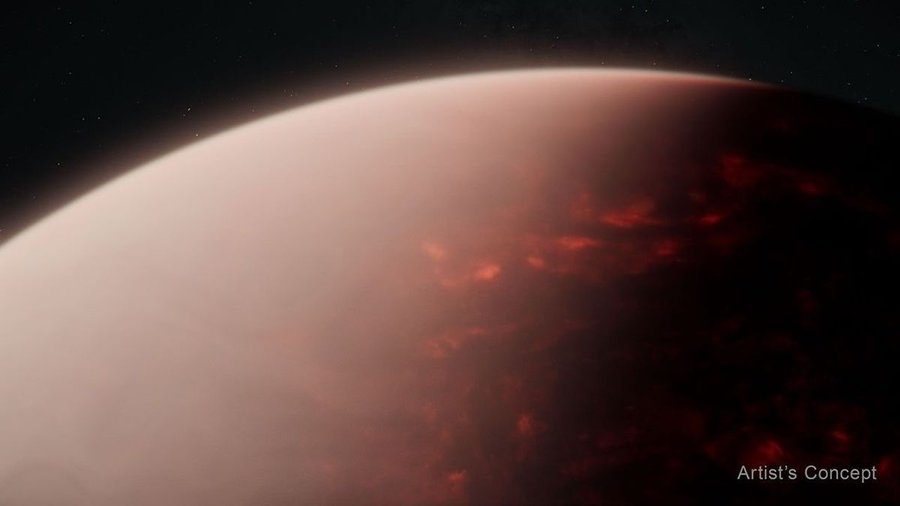
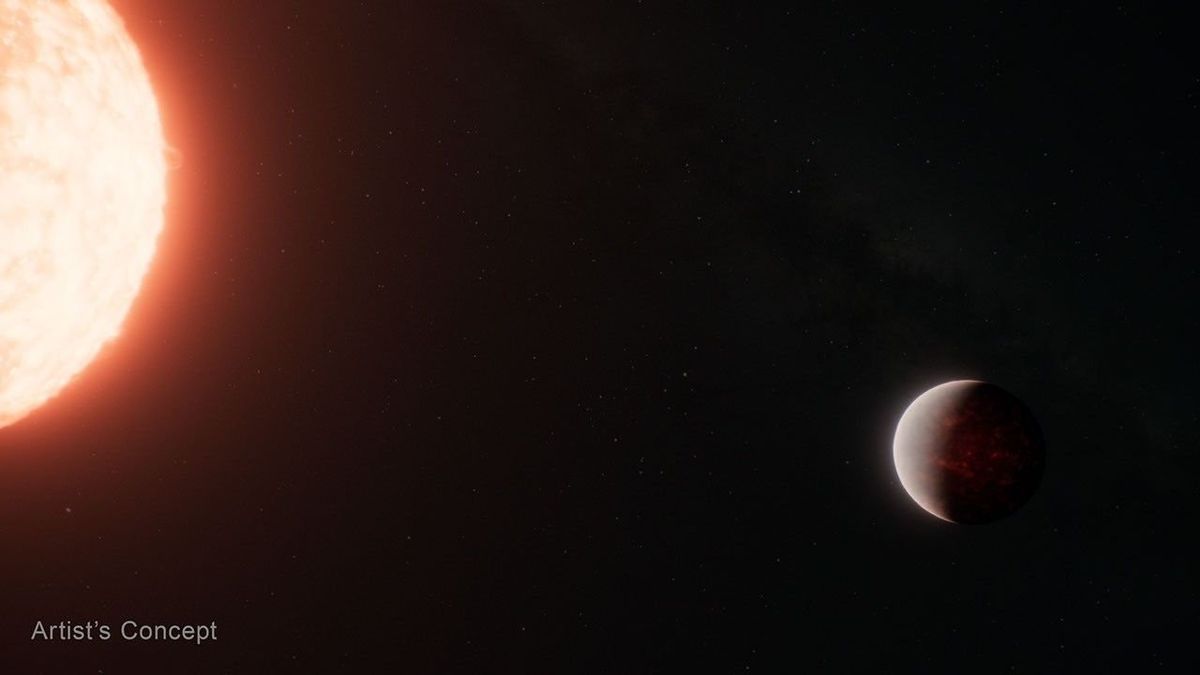
One more point of caution concerns the pictures. Webb does not image this planet. It shows up as a point of light blended with its star. Every picture of TOI-561 b, including the ones in this article, is an artist's concept. The NASA artwork here was made for the December 2025 release, not for the new paper, and shows a thick atmosphere over a magma ocean. The Birmingham and Waterloo releases use a different concept, credited to CryoDragon Inc. None of these shows the clouds from the new paper. They are illustrations of an idea.
§ 13What comes next
The authors say a definitive test of the detector discrepancy will need longer wavelengths. A Webb eclipse observation with its Mid-Infrared Instrument, called MIRI, could corroborate the low dayside flux. A MIRI phase curve would do more. It would independently measure the dayside and night-side temperatures and any hot-spot offset, and it would be more robust against stellar noise, because the star's variability is much smaller in the mid-infrared. The paper adds that the 15-micrometer carbon dioxide band falls in one of MIRI's filters, so phase curves in and out of that band could tell a carbon-dioxide-rich atmosphere from a carbon-dioxide-poor one. If carbon dioxide is present, it should show up on the night side as an absorption feature that further dims the night side at 15 micrometers.
Dang said in the releases that observing the planet at longer wavelengths with Webb could give insights and help explain how a planet this hot has held on to an atmosphere for billions of years. The releases do not say whether such observations have been scheduled, so I am not reporting one. The authors describe them as what they would like to do next.
There is a human note in the Waterloo release. Samuel Boucher, the paper's first author, began the project as an undergraduate research intern at the Trottier Institute for Research on Exoplanets, when Dang was a postdoctoral researcher there. She kept supervising him after she joined the University of Waterloo as a professor, and the internship project grew into a published Webb study.
So here is where things stand on October 27, 2026. A small, ancient, molten planet that circles its star in under eleven hours looks to be wrapped in an atmosphere that theory says should not be there, and that atmosphere appears to reflect about three-quarters of the starlight that reaches it. The best current idea is that clouds of silicate minerals, the same family of materials as sand and quartz, are doing the reflecting. That idea rests on models and has not been tested against the gas itself. The next observations will have to show what the gas is.
Watch & Listen
Hear this entry read aloud. Coming soon — the channels are not live yet.
Sources
The new result
- Boucher, Dang et al., "A Highly Reflective Atmosphere on the Lava World TOI-561 b Revealed by JWST/NIRSpec Phase Curve," The Astronomical Journal 172(4), published September 29, 2026
- arXiv preprint 2608.21519 (v1 August 21, 2026; v2 August 28, 2026)
- University of Birmingham, "Shiny lava planet challenges astronomers' expectations," October 27, 2026
- University of Waterloo, "Clouds on a lava planet challenge what astronomers expected"
The first Webb result and the planet's background
- NASA Science, "NASA's Webb Detects Thick Atmosphere Around Broiling Lava World," December 11, 2025
- Space Telescope Science Institute, release 2025-140
- Teske et al., "A Thick Volatile Atmosphere on the Ultrahot Super-Earth TOI-561 b," The Astrophysical Journal Letters 995(2), December 11, 2025 (arXiv preprint)
- Lacedelli et al., "An unusually low density ultra-short period super-Earth and three mini-Neptunes around the old star TOI-561," MNRAS 501, 4148 (2021) (arXiv preprint)
- Weiss et al., "The TESS-Keck Survey. II. An Ultra-short-period Rocky Planet and Its Siblings Transiting the Galactic Thick-disk Star TOI-561," The Astronomical Journal 161, 56 (2021)
- Lacedelli et al., "Investigating the architecture and internal structure of the TOI-561 system planets with CHEOPS, HARPS-N and TESS," MNRAS 511, 4551 (2022) (arXiv preprint)
Other lava worlds and reference data
- NASA Science, "NASA's Webb Hints at Possible Atmosphere Surrounding Rocky Exoplanet" (55 Cancri e)
- Hu et al., "A secondary atmosphere on the rocky exoplanet 55 Cancri e," Nature (2024)
- Kreidberg et al., "Absence of a thick atmosphere on the terrestrial exoplanet LHS 3844b," Nature (2019)
- NASA Space Science Data Coordinated Archive, Venus Fact Sheet (Bond albedo, Earth density and solar irradiance)
- NASA Science, Io
Images
- NASA, ESA, CSA, STScI release imagery for TOI-561 b (December 11, 2025) and 55 Cancri e (2024), via NASA Science, pages listed above.