Science
CRISPR and Gene Editing: From Cyberpunk Fiction to China's Labs, and What Is Actually True
By Darrell Wallen
Would you prefer to listen?
§ 1The games imagined it first
Tabletop games and cyberpunk novels imagined designed human bodies decades before the science could touch them, and a claim now spreading online says that imagined future has arrived in China while the West argues about ethics. The documented record, checked by The Ancient Sky against court filings, regulators, journals, government documents and company statements as of October 27, 2026, supports part of that claim, contradicts part of it, and leaves its most dramatic assertions unconfirmed.
Start with the fiction, because that is where the claim starts. William Gibson's novel Neuromancer, published in 1984, gave cyberpunk its look: a street-level future of corporations, hackers and bodies rebuilt with hardware. A year later Bruce Sterling published Schismatrix, a novel in which humanity splits into factions, some of whom rebuild themselves through genetic engineering and some through machines. Sterling's own reference entry and the science fiction databases date it to 1985, and it is often cited as an early picture of designed human beings.
Then the ideas moved to the gaming table. The Cyberpunk role-playing game from R. Talsorian Games appeared in 1988, and its later edition, Cyberpunk 2020, became a standard of the genre. Its world is mostly about cyberware, meaning replacement limbs and implants, along with cosmetic body sculpting. Genetics sits at the edges. The headline technology in that game is metal and wire.

Real gene editing runs the other way. It works on the letters of DNA, not on hardware, and its first approved product is a treatment for blood disease, not a replacement arm. That is the first gap between the game and the lab.
Shadowrun, from FASA in 1989, is a stranger case, because it mixes cyberpunk with fantasy. In the game's timeline, magic returns to the world on December 24, 2011, in an event the game calls the Awakening. On April 30, 2021, about ten percent of humans change into orks and trolls, an event players call goblinization. That is not gene editing. In the game it is magic. The in-universe science of designed bodies comes separately. Bioware, the game's name for organic enhancements, first appears in the fictional year 2052, and a later sourcebook called Augmentation introduced what fans call genetech. So when someone says Shadowrun predicted CRISPR, the accurate version is that it predicted the wish, not the method.
The wish is the part that matters. The games asked what happens when the body becomes something you can edit, and when only some people can afford the edit. That question returns at the end of this report, with a price attached.
§ 2The claim, and how it was checked
The claim being tested has three parts. Part one says science fiction imagined gene-engineered people before science could produce them. Part two says China is now ahead of everyone in doing it. Part three says the West is held back by ethics while China is not.
Part one is documented. Parts two and three are where the record gets more complicated, and where the evidence points somewhere different from the rumor.
Each finding below is labeled in one of three ways. Documented means The Ancient Sky opened a primary source or a credible outlet. Claimed means someone said it, sometimes someone important, but no supporting evidence was found. Unknown means the question cannot be answered from public records. Where a site blocked access and a source could not be opened directly, the report says so.
§ 3What CRISPR is, and who built it
The science starts with bacteria. CRISPR stands for clustered regularly interspaced short palindromic repeats. These are stretches of repeating DNA that Spanish microbiologist Francisco Mojica first noticed in microbes in the early 1990s. Over the following years researchers worked out that they are part of a bacterial immune system. Bacteria keep small snippets of virus DNA in those repeats. When the virus returns, the bacterium uses the snippet as a guide to find the invader and cut it.
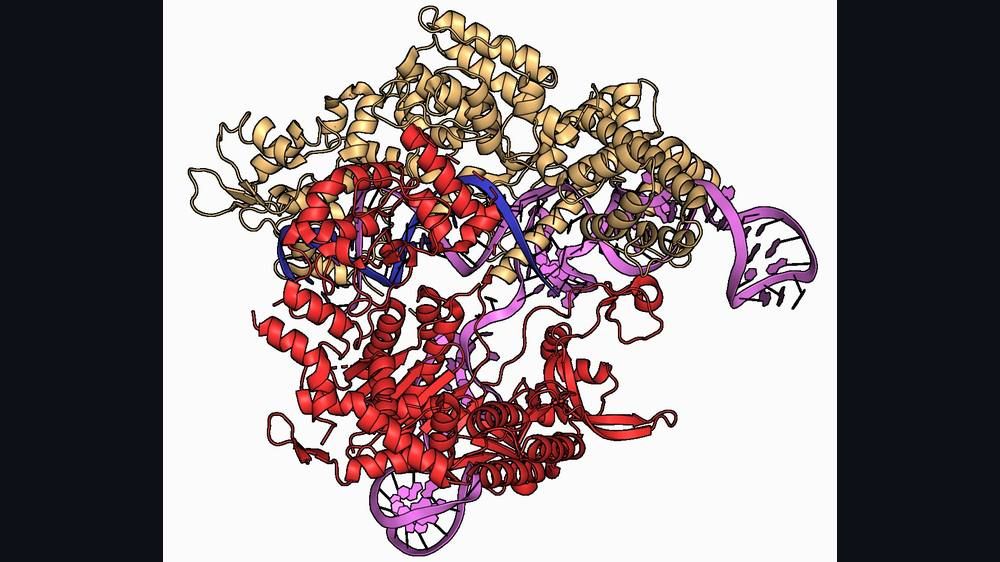

In August 2012, Martin Jinek, Jennifer Doudna, Emmanuelle Charpentier and colleagues published a paper in Science titled "A Programmable Dual-RNA-Guided DNA Endonuclease in Adaptive Bacterial Immunity." In plain terms, they showed that a protein called Cas9 could be pointed at a chosen stretch of DNA by a short piece of guide RNA, and that it would cut there. Change the guide, change the target.
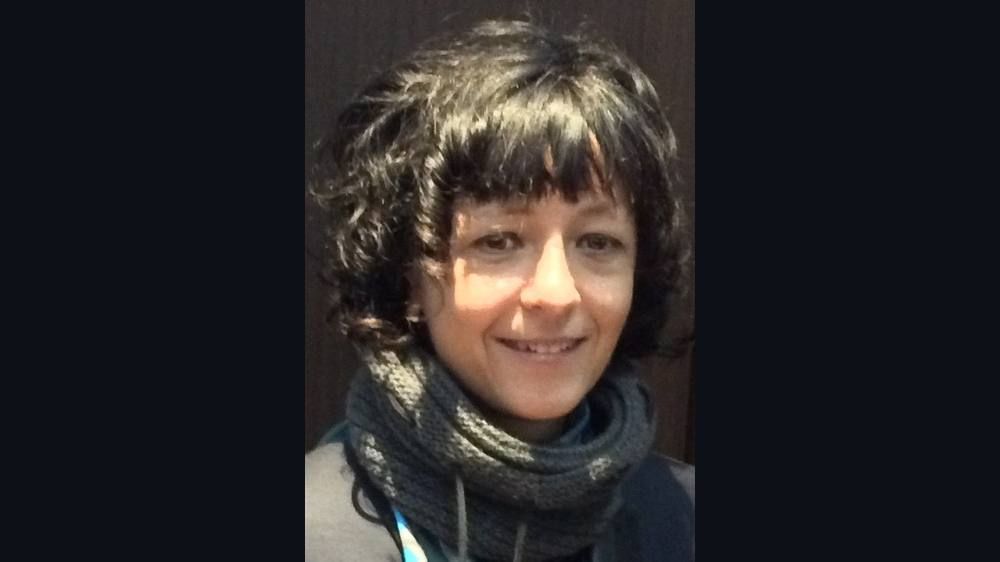

In February 2013, two papers in Science showed the method working in human cells. One was led by Feng Zhang's lab at the Broad Institute, with Le Cong as first author. The other came from George Church's lab, with Prashant Mali as first author.
The Nobel committee recognized Doudna and Charpentier with the 2020 Nobel Prize in Chemistry, announced on October 7, 2020, for what it called the development of a method for genome editing.


Zhang was not part of that prize. The patent fight between his institution and Doudna's university has been long and bitter.
That first generation of CRISPR cuts both strands of DNA. Cutting is blunt, and cells repair cuts imperfectly, so the field kept going. In 2016, David Liu's lab at Harvard and the Broad published base editing in Nature. Instead of cutting, a base editor chemically changes one letter of DNA into another. In 2019, Liu's lab published prime editing, also in Nature, described in its title as search-and-replace genome editing without double-strand breaks or donor DNA. The original method works like scissors. Base editing works like a pencil with an eraser. Prime editing works like find and replace. Shadowrun gave genetech a sourcebook. Real base editing got a paper in Nature.
§ 4The first approved medicines: Casgevy and Baby KJ
In medicine, CRISPR is no longer a promise. On November 16, 2023, the United Kingdom's medicines regulator, the MHRA, authorized a therapy called Casgevy, from Vertex Pharmaceuticals and CRISPR Therapeutics, for sickle cell disease and transfusion-dependent beta thalassemia. It was the first CRISPR-based medicine approved anywhere. The U.S. Food and Drug Administration followed on December 8, 2023, approving Casgevy and a competing gene therapy for sickle cell disease. The treatment takes a patient's own blood stem cells, edits them, and returns them.

It is also expensive. Vertex established a U.S. wholesale acquisition cost of 2.2 million dollars, according to its filing with the Securities and Exchange Commission on the day of approval. In England, the National Institute for Health and Care Excellence approved the treatment for severe sickle cell disease under managed access in January 2025, at a list price reported as 1.65 million pounds a course, with a confidential NHS discount. In its second quarter of 2026, according to Vertex's filing, Casgevy brought in 76 million dollars, up 78 percent from the previous quarter. That is real growth. It is also a reminder that the number of patients treated so far is small.
The second landmark is a boy known publicly as Baby KJ. Born with a severe metabolic disorder called CPS1 deficiency, he received a base-editing therapy that doctors at the Children's Hospital of Philadelphia and Penn Medicine designed and built for him in about six months. His first infusion came in late February 2025, with more doses that spring. The New England Journal of Medicine published the report in 2025. A medicine made for exactly one patient was once unthinkable. In February 2026, the FDA issued draft guidance on what it calls a plausible mechanism framework, aimed at making approvals possible for individualized therapies like that one.
Look at who did all of this. A French scientist, an American scientist, a British regulator, an American regulator, American and European companies, and a children's hospital in Philadelphia. That matters when the claim that China is ahead is tested later in this report.
§ 5The line crossed in 2018
Everything described so far edits the body of a patient. What fiction worried about, and what ethics debates still worry about, is editing the germline, meaning embryos, eggs or sperm, so that the change is inherited by every later generation.
On November 25 and 26, 2018, a researcher named He Jiankui, then at the Southern University of Science and Technology in Shenzhen, announced that twin girls, known by the pseudonyms Lulu and Nana, had been born with edited genes. He said he had edited a gene called CCR5 in embryos to try to make the children resistant to HIV, because their father was HIV positive. He presented at the Second International Summit on Human Genome Editing in Hong Kong a few days later. The audience reacted with alarm, and the summit's organizing committee called the work irresponsible.
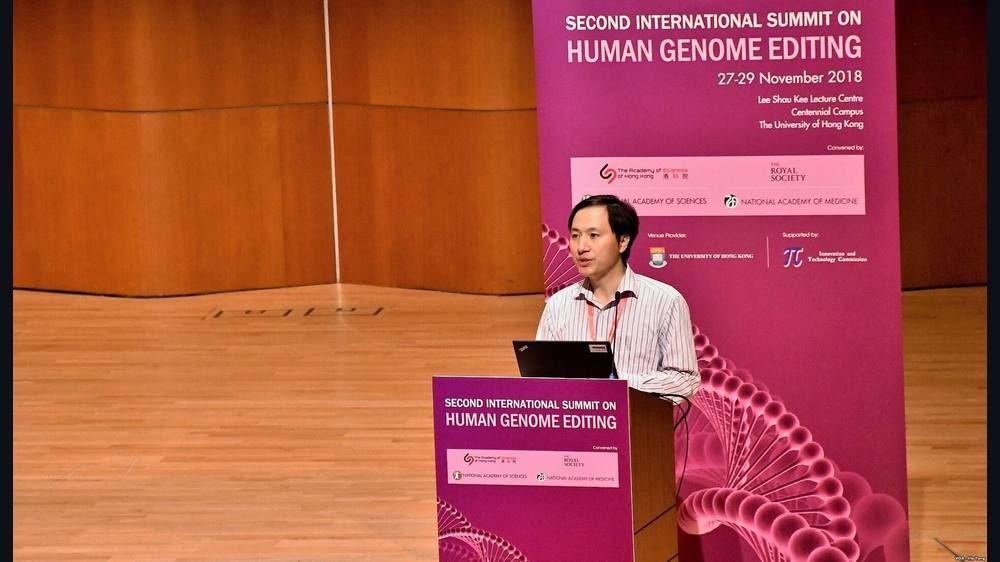

China's response is documented. On December 30, 2019, the Shenzhen Nanshan District People's Court convicted He, along with two colleagues, of illegal medical practice. According to Xinhua and China's own court system, He received three years in prison and a fine of three million yuan. Zhang Renli received two years and a one-million-yuan fine. Qin Jinzhou received an eighteen-month sentence with a two-year reprieve and a fine of 500,000 yuan. The court found that the team forged ethical review documents to recruit eight couples, and that two women became pregnant and three children were born in total.


He was released in April 2022. Since then he has tried to rebuild a career. He says he runs a private lab, and in 2024 he told MIT Technology Review that he would not make more gene-edited babies until society comes around. In January 2026, WIRED reported on his Beijing lab and an Alzheimer's project that works on human cell lines, mice and monkey embryos, not human embryos, and noted that he does not have a passport. In 2025 he married Cathy Tie, an entrepreneur who later separated from him and was barred from entering China, as the Guardian reported in May 2026. He has also posted on X that ethics is holding back scientific progress.
The point for this report is simple. China's response to the one confirmed case of a gene-edited baby was a criminal prosecution.
§ 6China's rulebook
Chinese rules today are laid out in a 2025 legal review in the Journal of Law and the Biosciences and in the primary texts behind it. Since March 1, 2021, Article 336-1 of China's Criminal Law, added by Amendment XI, makes it a crime to implant gene-edited or cloned human embryos into a human or an animal. The penalty is up to three years in prison, and three to seven years when the circumstances are especially serious. The Civil Code, which took effect in May 2020, says medical and scientific research involving human genes and embryos must not endanger human health or violate ethics. Rules on human genetic resources date to 2019, and a revised set of ethics review measures arrived in February 2023.
On July 8, 2024, China's Ministry of Science and Technology published Ethical Guidelines for Human Genome Editing Research. The official English text says that any clinical research involving germline genome editing is irresponsible and not allowed at present. A State Council regulation on clinical research and translation of new biomedical technologies reportedly took effect on May 1, 2026, with filing and approval steps through the National Health Commission. The Ancient Sky could confirm that regulation only through a summary of the government decree, not its full text.
China is not a country without ethics rules. It has criminalized heritable editing in its criminal code, while the comparable American restriction is an annual spending rider. That does not mean China is slow, however, and the next section covers the part of the claim that is true.
§ 7China's pace in the clinic
China is genuinely fast in clinical testing. In 2017, Science reported that China was sprinting ahead in the CRISPR therapy race, with nine of ten patient trials then listed in China, helped by a streamlined ethics review. Today the picture is more balanced but still striking. The CRISPR Medicine News global trials report for the second quarter of 2026, with data through July 31, counted 306 publicly disclosed gene-editing clinical trials. Of those, 143, or 46.7 percent, were in the United States, and 112, or 36.6 percent, were in China. The United Kingdom had 33, Australia 32 and Canada 25. China is a strong second, far ahead of every other country.
The Chinese product to watch is BRL-101, from BRL Medicine, an edited-cell therapy for transfusion-dependent beta thalassemia. In a release dated August 25, 2026, the company said its pivotal trial met its primary endpoint, with all thirty patients free of transfusions, and that the first two children treated in 2020 remain transfusion independent. As of the sources reviewed, it is not yet approved. Another Chinese company, CorrectSequence, received approval from China's drug regulator on April 2, 2024, to begin trials of a base-editing therapy called CS-101 for beta thalassemia.
So the part of the claim about China moving fast is documented. It applies to clinical trials in adults and children with serious disease. Every one of those trials is regulated, and the first approved CRISPR medicines are Western.
§ 8What the West restricts, and what it is doing anyway
The other half of the claim says the West is stuck on ethics. That is true, and it is written into law. In the United States, the Dickey-Wicker Amendment bars federal funding of research that creates or destroys human embryos. On top of that, Congress has attached a rider to FDA spending bills since late 2015 that stops the FDA from even reviewing an application for research in which a human embryo is intentionally modified with a heritable change. Science magazine described this in 2016 under the headline "The FDA is prohibited from going germline." A June 2026 analysis from the FDA Law Blog shows the provision appearing again, as Section 734, in the fiscal 2027 House appropriations bill.
In Europe, Article 13 of the Oviedo Convention, the Council of Europe's treaty on human rights and biomedicine, says an intervention to modify the human genome may only be for preventive, diagnostic or therapeutic purposes, and only if it does not aim to change the genome of any descendants. In the United Kingdom, the Human Fertilisation and Embryology Act allows licensed embryo research, with embryos kept no longer than fourteen days. A genome-edited embryo is not a permitted embryo, so it cannot be placed in a woman. The UK regulator, the HFEA, did license gene-editing research by Kathy Niakan's lab, with the clear rule that nothing is transferred.
International summits have said the same thing repeatedly. In 2015 the first summit said it would be irresponsible to proceed with clinical germline editing until safety and efficacy questions were resolved and there was broad societal consensus. In 2018 the second summit called the Hong Kong announcement irresponsible. In March 2023 the third summit's committee said heritable editing remains unacceptable at this time. In May 2025, the International Society for Cell and Gene Therapy, the American Society of Gene and Cell Therapy and the Alliance for Regenerative Medicine called for a ten-year moratorium. A 2025 global observatory summit issued a statement that was a charter for discussion, not a moratorium.
Even so, the loudest steps toward editing human embryos in 2025 and 2026 came from the United States and the United Kingdom. A startup called Preventive, led by Lucas Harrington and reported to have raised about thirty million dollars as a public benefit corporation, announced it was researching whether embryo editing can be done safely. The Wall Street Journal reported that it had considered the United Arab Emirates as a place to work and had identified a couple. Harrington disputed that report. Press accounts name tech investors as backers, but The Ancient Sky found that only secondhand, so it should be treated as reported, not confirmed.
A second company, Origin Genomics, is run by Cathy Tie, the same entrepreneur who married He Jiankui. According to a pharmaceutical trade outlet, and a September 2026 NPR report that The Ancient Sky could see only in a search excerpt, it has gained approval from a U.S. institutional review board for laboratory work on embryos, and it has not implanted any.
The academic side moved too. CNN reported on July 8, 2026 that two research groups had published or were about to publish work editing human embryos. A University of Cambridge team led by Kathy Niakan published base editing in human embryos in Nature on June 25, 2026, showing that a gene called NANOG is essential for early development. A Columbia University group, led by Dieter Egli, edited genes called PCSK9 and HBG, with a journal conditionally accepting the work. Both groups found that edits could be mosaic, meaning not every cell is changed the same way, and that unintended edits happened. Neither transferred an embryo into a woman. CNN also noted that roughly seventy countries ban germline editing in law.
As of October 2026, the people openly raising money to edit human embryos are in the West. That is not the same as saying the West is ahead, because none of them has made a baby. But it is not a picture of a West paralyzed while China sprints.
§ 9Rumor check one: Chinese super soldiers
Now the rumors, beginning with the biggest. On December 3, 2020, John Ratcliffe, then Director of National Intelligence, wrote an opinion piece in the Wall Street Journal about China. The passage reads, quote: "U.S. intelligence shows that China has even conducted human testing on members of the People's Liberation Army in hope of developing soldiers with biologically enhanced capabilities. There are no ethical boundaries to Beijing's pursuit of power." End quote.
That passage is the origin of nearly every super soldier video now circulating. NBC News reported that Ratcliffe's office and the CIA did not elaborate, and that no evidence was made public. Snopes rated the claim Unproven in March 2021. The BBC, in a February 2021 piece, noted that China called the claim a "miscellany of lies," and raised doubts that editing adult genes to enhance performance is even feasible. A Reuters report cited in search results says China dismissed it as fake news, though The Ancient Sky could not open that report directly.
The surrounding context is documented. A 2019 paper from the Center for a New American Security by Elsa Kania and Wilson VornDick describes China's military-civil fusion strategy and names CRISPR as a priority. In December 2021, the U.S. Commerce Department added the Academy of Military Medical Sciences and eleven of its institutes to the Entity List, saying in the Federal Register that they use biotechnology to support military end uses, including, in its words, "purported brain-control weaponry." The word is purported. The same notice does not mention gene-edited soldiers.
A 2024 State Department advisory board report on China's military-civil fusion strategy says analysts worry about sponsorship of research on gene editing and human performance enhancement. It cites a CNAS finding that since 2016 the Central Military Commission has funded projects on military brain science, advanced biomimetic systems and human performance enhancement. It also says some PLA writings may be considered thought pieces. In April 2025, the congressional National Security Commission on Emerging Biotechnology wrote that drone warfare will seem quaint if the United States faces genetically enhanced PLA super soldiers. That is a warning about what could happen, not evidence of what exists.
The classification is this. It is documented that the U.S. government made the statement, and documented that the PLA and its research institutes are interested in biotechnology and human performance. It is claimed that human testing took place. It is unverified that any gene-edited soldier exists, because no evidence has been released, China denies it, and independent fact checkers found nothing. A dramatic video is not evidence. Sensational videos on this topic draw enormous audiences, and they do harm, because they make the real questions about military biotechnology easy to dismiss. None of them are linked here.
§ 10Rumor check two: designer babies and unregulated embryo editing
The second rumor says China is quietly editing embryos on a large scale and producing designer babies. What is documented is one confirmed case, He Jiankui in 2018, which led to a prosecution. In April 2015, a group at Sun Yat-sen University led by Junjiu Huang had published, in the journal Protein and Cell, an experiment editing human embryos that could not develop into babies, which set off a global alarm. Chinese law has since gone the other way, with the criminal provision of 2021 and the 2024 guidelines.
A 2019 survey discussed in the legal review found that 47.7 percent of respondents supported both gene therapy and gene enhancement. That says something about public openness, though not about practice.
What is claimed is He's own plans. In 2026 he told reporters about a lab and about interest in Hong Kong or South Africa, and Cathy Tie's company says it is working on correcting genes in embryos under American oversight. What is unverified is any Chinese embryo-editing pregnancy since 2018. The Ancient Sky searched for one and found none. That is not proof that none exists, because secrecy cannot be disproved. But a claim of a hidden program has to be backed by evidence, and none has been shown. If anything, the visible embryo-editing story from 2025 to 2026 is a Western one.
§ 11Rumor check three: gene-edited monkeys, dogs, pigs and myopia
The third rumor concerns animals, and here the record is rich, which is part of why the rumor mill likes it. In February 2014 in Cell, a team from Nanjing and Yunnan led by Niu and colleagues reported the first gene-modified monkeys made with CRISPR. In January 2018, a team at the Shanghai Institute of Neuroscience reported Zhong Zhong and Hua Hua, two macaques cloned from a body cell. That was cloning, not gene editing, though the two are often confused. In 2015, a team in Guangzhou reported two beagles, Hercules and Tiangou, with the myostatin gene removed so they would be more muscular. The researchers said the goal was to build disease models, though one scientist told MIT Technology Review that police and military uses had been discussed. Also in 2015, BGI announced that it would sell gene-edited micropigs as pets for about 1,600 dollars. It dropped that plan by 2017.
In 2025, Chinese surgeons reported using gene-edited pig organs. They described a pig kidney with six edited genes in a living patient, and a gene-modified pig liver in a brain-dead recipient, published in Nature in March 2025. A third case, an auxiliary pig liver in a living patient, was reported in the Journal of Hepatology. In that case the graft was removed after thirty-eight days, and the patient died on day 171. These cases are real and serious, and they are medicine, not weapons.
One more claim has circulated, that children or monkeys have been gene-edited in China to treat or prevent nearsightedness. The Ancient Sky searched for evidence and found none. The Chinese myopia genetics work found was observational, or done in mice. This claim is unverified, with no documentation found.
§ 12What the evidence says about the claim
Taking the three parts together, part one holds. Science fiction anticipated designed people, with the caveat that Shadowrun's famous transformation was magic. Part two holds in part. China has about thirty-seven percent of the world's disclosed gene-editing trials, second only to the United States, and it moves quickly. But the first approved gene-editing medicines are Western, the first personalized base-editing treatment was done in Philadelphia, and the loudest embryo-editing efforts are in the United States and United Kingdom. Part three is half true. The West does argue, in law and in public. But China has made heritable editing a crime, prosecuted its one known offender, and published guidelines calling germline clinical work not allowed.
The sharper version of the story is this. Both sides are doing the medicine. Both sides say no to engineered babies. The unresolved question is who breaks that agreement first, and whether it will be a laboratory in a place with less oversight or a private company in a place with more money. He Jiankui, in his own telling, wants to work in Hong Kong or South Africa, not Beijing. The Wall Street Journal reported that a Western company had considered the United Arab Emirates, which the company's chief executive disputes. The competition is not East against West. It is regulated places against jurisdictions that are still deciding.
§ 13What is known, claimed and unknown
As of October 27, 2026, this is where the record stands.
What is known. CRISPR-based medicine is real and approved, starting with Casgevy in 2023. A personalized base-editing treatment worked for one infant. China runs about thirty-seven percent of the world's disclosed gene-editing trials. China criminalized heritable human editing in 2021, and its science ministry published guidelines in 2024 declaring germline clinical work not allowed. A convicted researcher, He Jiankui, is working on projects that do not involve human embryos. Western companies and universities are the ones now publicly working on embryo editing in the lab.
What is claimed. That China has done human gene-editing tests on soldiers. That China is secretly producing designer babies. That gene-edited animals are being made for military use. These claims have come from officials, commentators and viral videos.
What is unknown. Whether any secret program exists. The Ancient Sky could not verify one, and the people who say there is one have not shown anything. Other questions have no documented answer yet: how safe embryo editing could ever be, what it would cost, and who would get to buy it.
The games asked what happens when the body can be edited and only some can afford it. The first answer arrived in 2023, at a price of 2.2 million dollars. That is a real question for 2026, and it does not need a rumor to make it urgent. Thanks for listening. Stay curious, and check the sources.
Watch & Listen
Hear this entry read aloud. Coming soon — the channels are not live yet.
Sources
Fiction and games
- Cyberpunk (R. Talsorian, 1988) at the TSR Archive
- Gizmodo, "Shadowrun, the cyberpunk fantasy game that couldn't keep going"
- Lantern Hall, Shadowrun
- Shadowrun first-edition reference timeline
- Bruce Sterling, Science Fiction Encyclopedia
- Schismatrix, EBSCO research starter
- Schismatrix, ISFDB
- Grokipedia, Shadowrun
- Grokipedia, Bruce Sterling
CRISPR science (papers and prizes)
- Jinek et al., Science, Aug 17, 2012 (free full text, PubMed Central)
- Cong et al., Science, Feb 15, 2013 (free full text, PubMed Central)
- Mali et al., Science, Feb 15, 2013 (free full text, PubMed Central)
- Komor et al., base editing, Nature, Apr 20, 2016
- Anzalone et al., prime editing, Nature, Oct 21, 2019
- The Nobel Prize in Chemistry 2020, press release
- Grokipedia, CRISPR
- Grokipedia, Jennifer Doudna
- Grokipedia, Emmanuelle Charpentier
- Grokipedia, Feng Zhang
- Grokipedia, Base editing
- Grokipedia, Prime editing
Approved therapies, costs and personalized editing
- MHRA, world-first authorization of Casgevy, Nov 16, 2023
- FDA, first gene therapies for sickle cell disease, Dec 8, 2023
- Vertex Pharmaceuticals, SEC filing (Form 8-K), Dec 8, 2023, U.S. wholesale acquisition cost of $2.2 million for Casgevy (the SEC site answers requests that identify themselves and may refuse a generic browser)
- NICE, approval of exa-cel for severe sickle cell disease
- NICE guidance TA1044
- Musunuru et al., Baby KJ, New England Journal of Medicine, May 15, 2025 (PubMed record with abstract)
- Penn Medicine, first personalized CRISPR therapy
- FDA, plausible mechanism framework launch, Feb 2026
- Federal Register, plausible mechanism draft guidance, Feb 25, 2026
He Jiankui and the 2018 case
- Xinhua, sentence, Dec 30, 2019
- China Courts (English), Dec 31, 2019
- Supreme People's Court of China (Chinese)
- MIT Technology Review, He released from prison, Apr 4, 2022
- Nature news, Apr 2022
- Petrie-Flom Center, Harvard, Mar 8, 2023
- MIT Technology Review, He promises no more gene-edited babies for now, Jul 26, 2024
- WIRED, Jan 20, 2026
- Center for Genetics and Society, reposting WSJ, Mar 26, 2025
- The Guardian, Cathy Tie, May 30, 2026
- Liang et al., Protein & Cell, Apr 2015 (free full text, PubMed Central)
- Grokipedia, He Jiankui
- Grokipedia, Human germline engineering
China: law, regulation and clinical pace
- Zou, Li and Tao, Journal of Law and the Biosciences, 2025 (legal review)
- Criminal Law Amendment XI, English translation (China Law Translate)
- Library of Congress, Global Legal Monitor, Feb 26, 2021 (not opened directly)
- Ministry of Science and Technology, Ethical Guidelines for Human Genome Editing Research, Jul 8, 2024 (English, State Council)
- Ministry of Science and Technology (Chinese)
- State Council regulation on clinical research and translation of new biomedical technologies, effective May 1, 2026 (details from a search summary; confirm against the text)
- CRISPR Medicine News, Q2 2026 Global Clinical Trials Report
- CRISPR Medicine News, clinical trials overview
- Normile, Science, 2017, "China sprints ahead in CRISPR therapy race" (not opened directly; the site refuses automated checks)
- BRL Medicine, BRL-101 pivotal results, Aug 25, 2026
- CorrectSequence Therapeutics, CS-101 base-editing therapy approved for trials by China's NMPA, Apr 2, 2024
- Nature Reviews Drug Discovery, trends in cell and gene therapy in China, Jul 31, 2025 (abstract only)
The West: law, summits and statements
- FDA Law Blog, FY2027 appropriations report, Jun 2026
- Science, "The FDA is prohibited from going germline," 2016 (not opened directly; the site refuses automated checks)
- Council of Europe, Oviedo Convention (CETS 164), Article 13
- HFEA, applying for a research licence
- Human Fertilisation and Embryology Act 2008, section 3
- National Academies, 2015 International Summit statement
- National Academies, 2018 Second Summit committee statement
- Royal Society, 2023 Third Summit statement
- Alliance for Regenerative Medicine, 10-year moratorium call, May 27, 2025
- ASGCT, moratorium policy statement, May 2025
- Global Observatory, 2025 summit statement
Embryo-editing companies and research, 2025 to 2026
- Preventive, announcement
- MIT Technology Review, Oct 31, 2025
- Wall Street Journal, tech billionaires and genetically engineered babies (not opened directly; paywalled)
- KQED Forum, Bay Area startups and engineered babies
- NPR, Sep 29, 2026 (not opened directly; search excerpt only)
- Pharma Device News on Origin Genomics
- CNN, Jul 8, 2026
- Bower et al., Nature, Jun 25, 2026
- University of Cambridge news release
Rumor check: PLA and "super soldiers"
- Ratcliffe, "China Is National Security Threat No. 1," Wall Street Journal, Dec 3, 2020 (paywalled; the quotation is also reported by NBC News and The Guardian below)
- NBC News, Dec 3, 2020
- The Guardian, Dec 4, 2020
- Snopes, "Is China genetically engineering super soldiers?", Mar 1, 2021 (rated Unproven)
- BBC, "The myth and reality of the super soldier," Feb 8, 2021
- Kania and VornDick, CNAS, Oct 8, 2019
- Federal Register, Entity List additions, Dec 17, 2021
- National Security Commission on Emerging Biotechnology, final report executive summary
- State Department ISAB, report on biotechnology in China's military-civil fusion strategy, Nov 12, 2024
Rumor check: animals
- Niu et al., Cell, 2014, gene-modified monkeys
- Liu et al., Cell, 2018, cloned macaques (PubMed record)
- Chinese Academy of Sciences, cloned monkeys, Jan 2018
- MIT Technology Review, first gene-edited dogs, Oct 19, 2015
- Nature news, BGI micropigs, 2015
- MIT Technology Review, BGI drops gene-edited pets, Jul 3, 2017
- Tao et al., Nature, Mar 26, 2025, gene-modified pig liver xenotransplant
- Journal of Hepatology, auxiliary pig liver in a living patient, Oct 2025 (PubMed record with abstract)
- AP, pig kidney and liver xenotransplants in China (not opened directly; the site refuses automated checks)
- Grokipedia, Zhong Zhong and Hua Hua
- Grokipedia, Xenotransplantation
Videos (views checked October 27, 2026)
- Kurzgesagt, "Genetic Engineering Will Change Everything Forever – CRISPR," 30,755,002 views
- TED, Jennifer Doudna, "How CRISPR lets us edit our DNA," 1,937,190 views
- Associated Press, "First gene-edited babies reported in China," 85,618 views
- World Science Festival, "He Jiankui and the World's First Gene-edited Babies," 71,101 views
- PBS NOVA, Human Nature (documentary, views not available)
- Alarm-style "super soldier" videos with far higher view counts exist; none were linked.
Images
- Cas9 structure (PDB 4OO8): Deposition authors Nishimasu, Ishitani and Nureki, via Wikimedia Commons (CC0)
- Jennifer Doudna: Duncan Hull, via Wikimedia Commons (CC BY-SA 4.0)
- Emmanuelle Charpentier: Carries mum, via Wikimedia Commons (CC BY-SA 4.0)
- He Jiankui at the Second International Summit: Iris Tong, Voice of America, via Wikimedia Commons (public domain)
- Shenzhen skyline from Nanshan: Simbaxu, via Wikimedia Commons (CC BY-SA 4.0)
- Two AI-generated illustrations, labeled as such in the article.
Books
- William Gibson, Neuromancer (Ace, 1984).
- Bruce Sterling, Schismatrix (Arbor House, 1985).
- Jennifer Doudna and Samuel Sternberg, A Crack in Creation (Houghton Mifflin Harcourt, 2017).
- Walter Isaacson, The Code Breaker (Simon & Schuster, 2021).