Ancient Civilization
They Were There: The Alaskan Camp That Is Reshaping the Story of the First Americans
By Darrell Wallen
Would you prefer to listen?
Archaeologists reported on October 14, 2026, that a ridge above the Tanana River in interior Alaska holds a camp dated to about 13,800 years ago, with a probable lean-to shelter, hearths, an earth oven, eyed bone needles and diamond-shaped stone blades. The paper in Science Advances calls it the "earliest potential case of a habitation structure in North America." It does not claim the oldest site in Beringia, and it does not claim dogs.
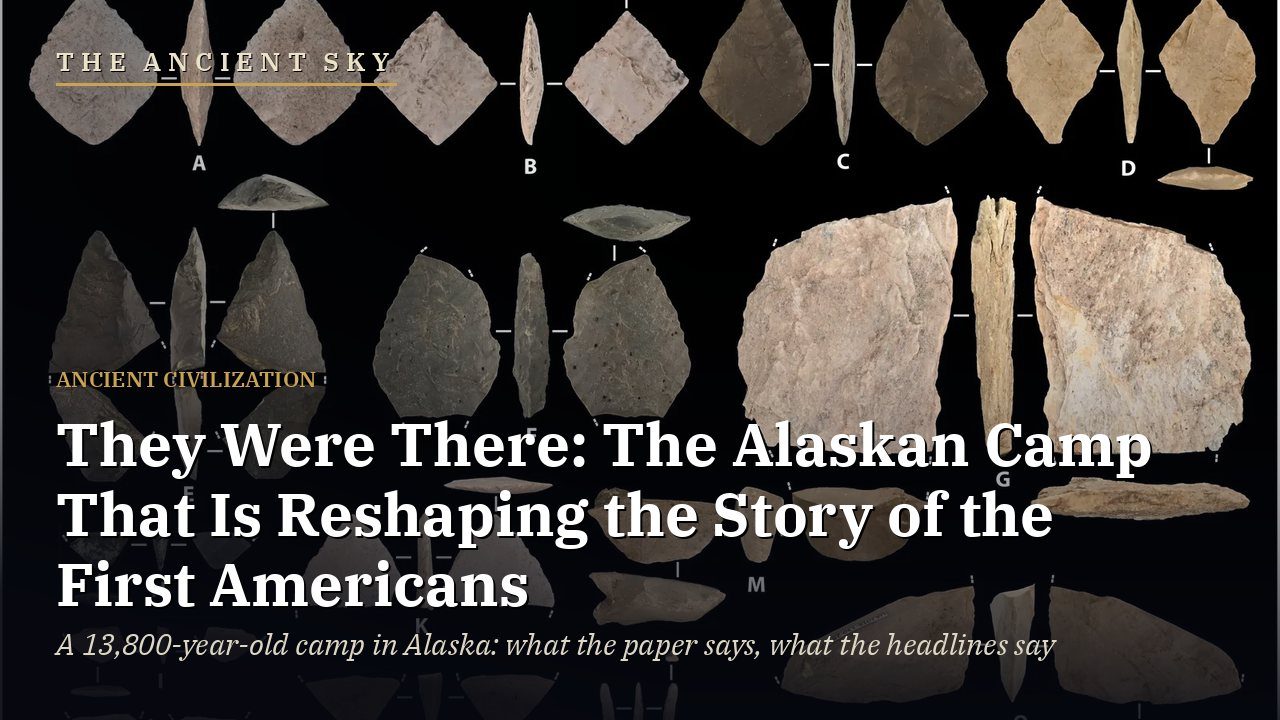
A team led by Kelly Graf of the University of Kansas reported on October 14, 2026, in the journal Science Advances, that a site called Shég' Xdaltth'í', about thirty-four miles southeast of Fairbanks, Alaska, preserves an early base camp from roughly 13,800 years ago. The name was given by Alaska Native elders and means "They were there" in an Athabascan language. The site was formerly called McDonald Creek and carries the state number FAI-02043.
The study is titled "Highlights from an early base camp in Beringia 13,800 years ago: Shég' Xdaltth'í' and the Late Pleistocene peopling of Alaska." Headlines have called it the oldest home in the Americas, a camp that rewrites the settling of the continent, and a place with the earliest pet dogs. Some of that is in the paper. Some of it is not. This article sorts out which is which, places the find in the long argument about who the first Americans were, and treats both the mainstream view and the alternative one fairly.
§ 1What the paper actually says
Sixteen authors are listed, from universities and institutes that include ones in France and Germany. Kelly Graf is the first author. Ted Goebel, also of the University of Kansas, is the second. Two of them are Indigenous tribal representatives: Evelynn Combs of the Healy Lake Tribal Council and Donald Charlie of the Nenana Native Association. According to the paper, the site lies on the traditional lands of today's Mendas Cha'ag and Nenana communities of Tanana Athabaskan people. The excavations were funded mostly by the National Science Foundation, and the U.S. Army Garrison Alaska at Fort Wainwright is thanked for permitting and logistical support. The paper is open access under a Creative Commons non-commercial license, which is why some of its figures appear in this article, with a credit line under each.
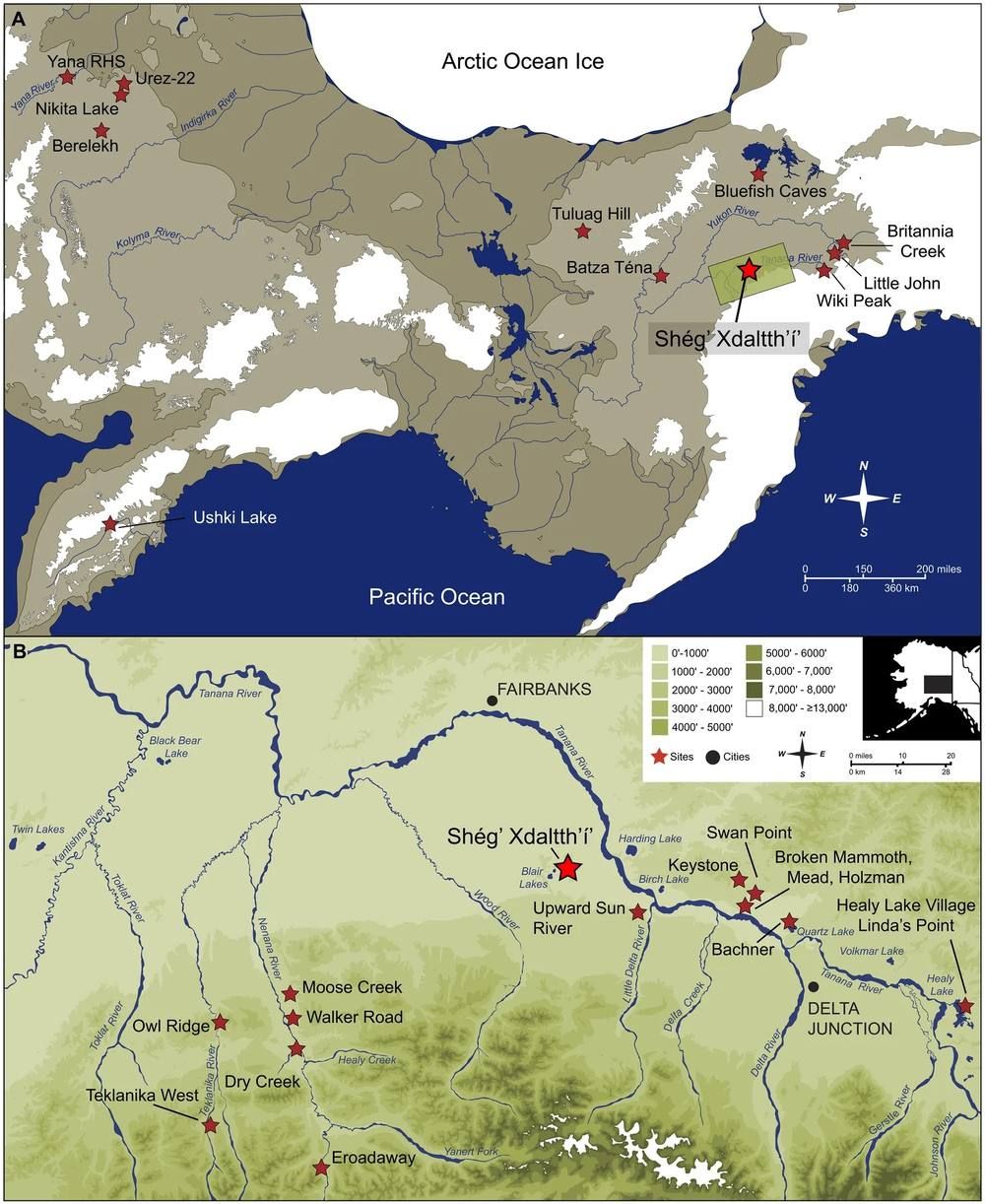
The first correction concerns the word "oldest." Several outlets, including Live Science, headlined the find as the oldest dwelling in the Western Hemisphere. The paper's own wording is more careful. It calls the feature "the earliest potential case of a habitation structure in North America" and, describing it, says the evidence suggests an artificial shelter, "most likely a partially covered lean-to structure that opened to the south." The word "potential" is doing real work. The paper also makes clear that this is not the oldest site in the region. Swan Point, in the same part of Alaska, has produced dates around 14,200 years ago, and the authors note that sites farther afield have been argued to be older. What makes Shég' Xdaltth'í' special is not that it is first, but that it is rich, deeply layered and carefully excavated.
The second correction concerns time. Popular Mechanics wrote that people returned to the place over roughly a thousand years. That is true of the site as a whole, which has three cultural layers separated by long gaps. But the oldest and richest layer, called Component 1, is modeled in the paper as lasting 284 years, give or take 34. That is still a long time, longer than the United States has existed, but it is not a millennium.
§ 2The ridge above the Tanana
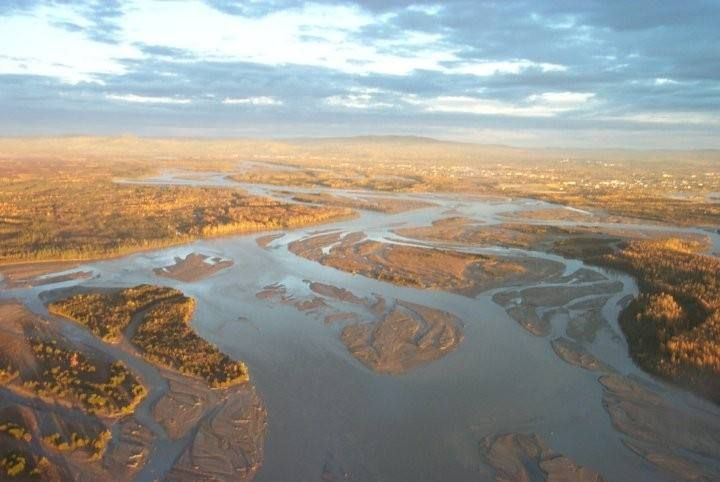
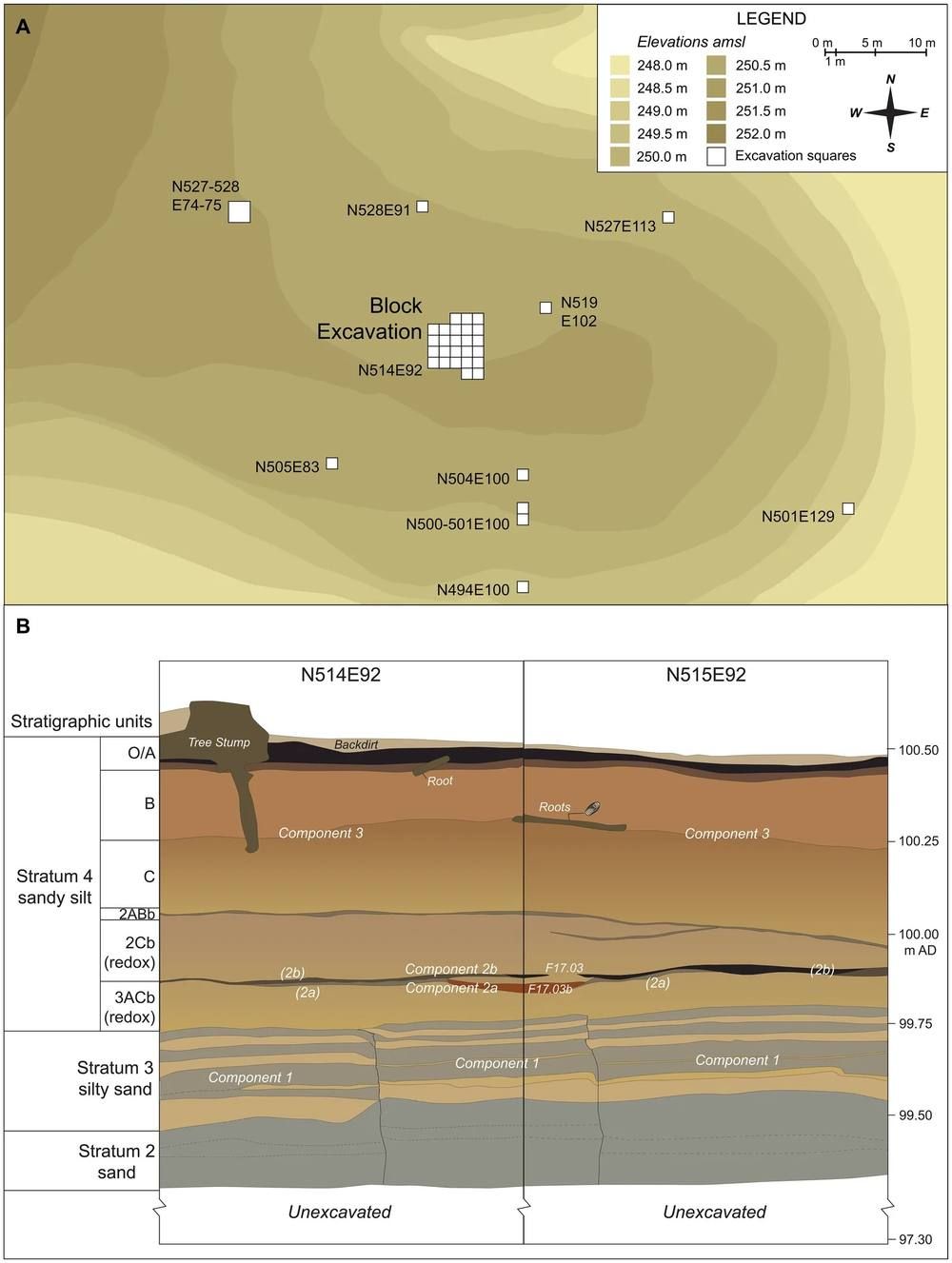
The site sits on a ridge about thirty-five meters above the Tanana River, fifty-five kilometers south-southeast of Fairbanks. The paper describes the river system as braided, flowing across a broad plain. The team has worked there since 2013, with a main excavation block of twenty-five square meters that was expanded from a test pit beginning in 2016. That sounds small, and it is. Testing indicates the site covers at least 4,800 square meters, so the excavated block is around half of one percent of the known area. Even so, the paper describes Component 1 as composed of more than 80,000 archaeological specimens. Its discussion section gives more than 70,000 associated artifacts, faunal remains and ecofacts, and says nearly 51,000 items, including artifacts, bones, charcoal and features, were mapped in three dimensions. The paper does not reconcile the two totals in the text reviewed here. Most are tiny flakes of stone and fragments of bone, which is typical of a camp where tools were made and repaired and meals were cooked.

The soil matters as much as the artifacts. The deposits are wind-blown silt, called loess, laid down gradually in the Late Pleistocene, which keeps the layers clean and separable. That is a good setting for an archaeologist, because things dropped on a surface get buried quickly and stay in place. The oldest layer, Component 1, forms a discrete layer about ten centimeters thick. Above it lie two shorter occupations, Component 2a and 2b, which the model dates to roughly 13,080 to 12,840 and 12,820 to 12,640 years ago, and Component 3, which is much later and spans about 6,170 to 3,240 years ago.
§ 3How the date was built
The headline number, 13,800 years, deserves a closer look, because it is the product of a model, not a reading off a single sample. The team obtained sixty-six accelerator mass spectrometry radiocarbon dates from the main excavation block. Fifty of them came from Component 1, on thirty-four samples of willow charcoal and sixteen bones, including bison, horse, mammoth, wolf, hare and birds. The team calibrated the dates and fed them into a Bayesian model built with the standard software OxCal, which combines the dates with what is known about the order of the layers. The result puts Component 1 at about 13,850 to 13,500 calendar years ago. The dwelling-like oval comes out at around 13,800 to 13,630, based on thirteen modeled dates, twelve of them on willow charcoal.
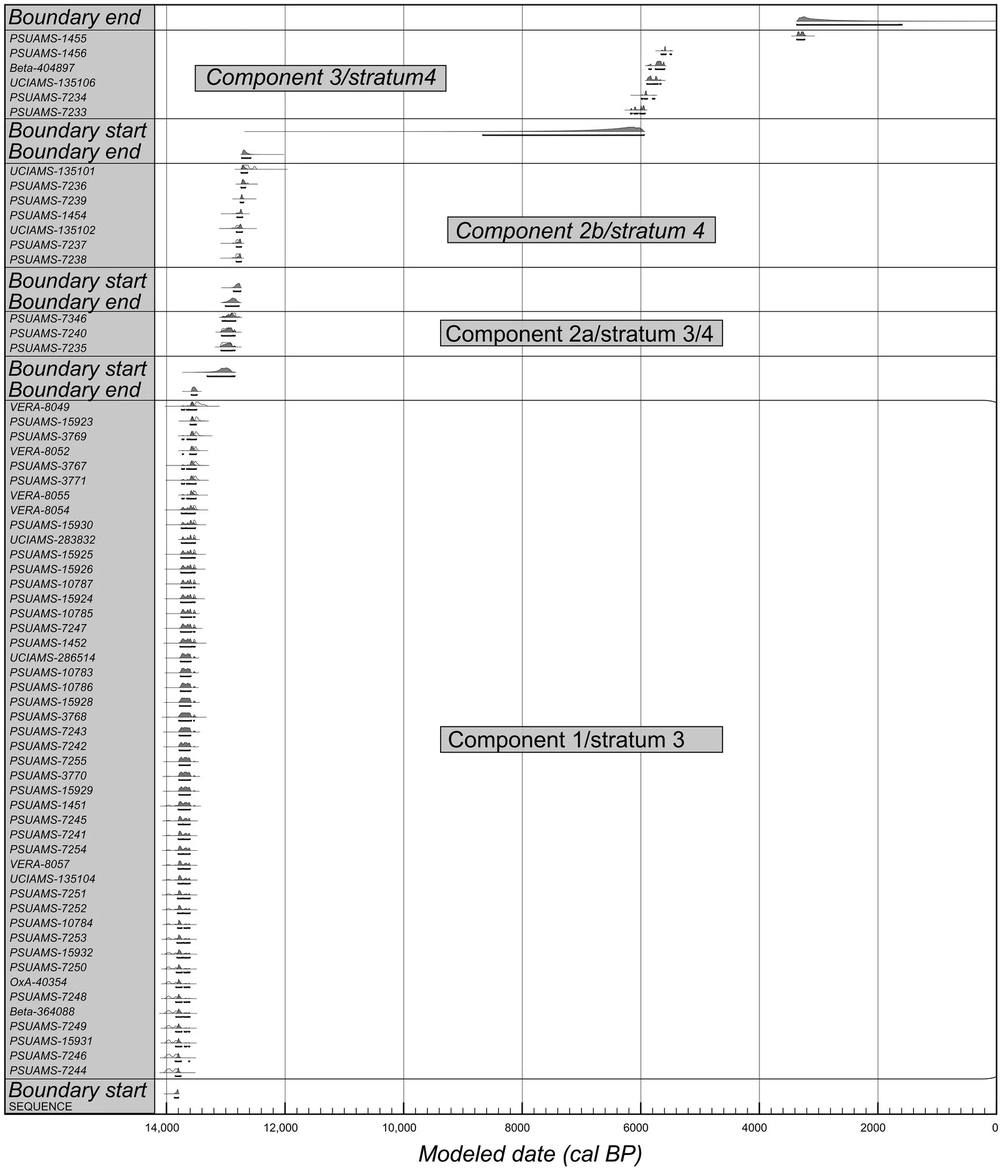
The paper states the wrinkles. Four of the fifty dates in Component 1 were treated as outliers and removed from the model, after the model flagged them as incongruent with the rest. One tiny sample from Component 2b was judged by the authors to be probably a burned rootlet, a "root burn" from 1,500 to 1,200 radiocarbon years later. And the authors acknowledge that the model "considerably narrowed" the age range of the lowest layer, potentially ignoring signs of multiple occupation events starting as early as about 14,050 years ago and as late as about 13,120. A skeptical reader might say that removing dates always raises the question of whether they were removed for good reason. A fair reader would reply that the authors list the dates, explain the removals and ran the model in three versions. Anyone can re-run the numbers from the published data, and that is how the question gets settled.
§ 4What the camp looked like
The features in the oldest layer are the core of the case for a base camp. The paper describes eight. Feature 18.02a is an oval stain of charcoal-darkened, greasy-textured sediment at least three meters across, with a hearth inside it, a small pit nearby and a possible postmold, the stain left by a rotted wooden post. The authors read it as the footprint of an ephemeral lean-to or tent frame. Hammering of bone on an anvil stone appears to have taken place at its opening, and a bone-discard pile lay a few meters away. Nearby was an earth oven, a pit for slow cooking, which the paper says was probably fired on multiple occasions given a modeled range of about 200 years.
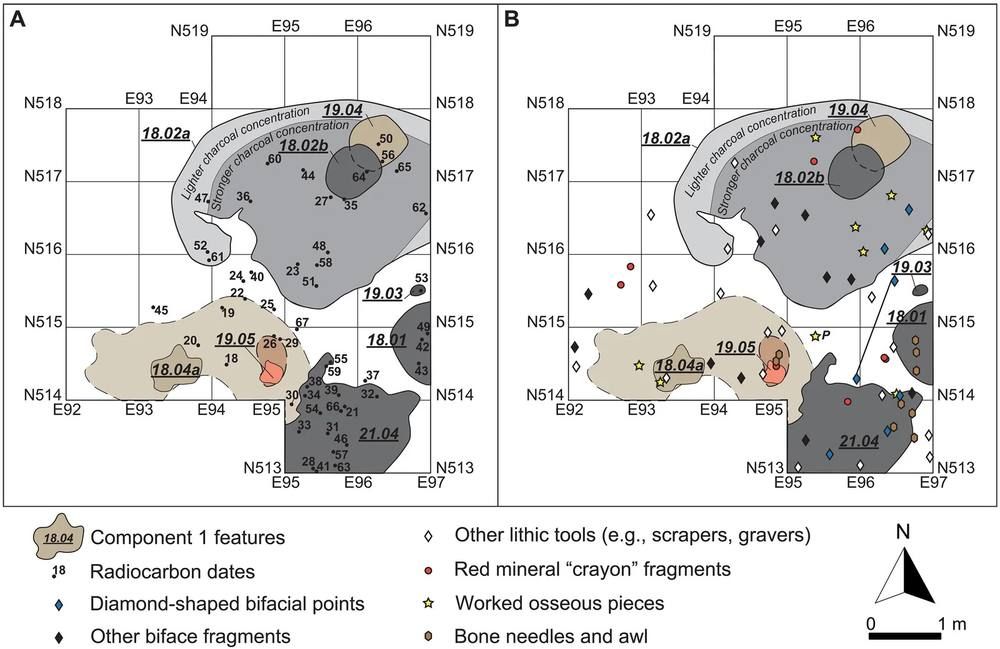
Does that add up to a home? The honest answer is that it adds up to a plausible shelter. Charcoal staining, a post and a hearth in the right arrangement is the kind of evidence archaeologists around the world accept for ancient shelters. But it is also, as the word "potential" signals, an interpretation of faint traces in soil. Nobody found a wall.
The phrase "base camp" is a second interpretation. The authors say the density of remains, the variety of activities, the evidence for cooking, sewing and tool making, and the repeated returns are more consistent with a base camp than with a short hunting stop, and they call the occupation "semisettled." They also note that the obvious storage pits and substantial semisubterranean houses seen at permanent Siberian sites are lacking. Most known Beringian sites are small scatters from short visits, so a place with tens of thousands of artifacts is a rare window.
§ 5Needles, blades, and stone from far away
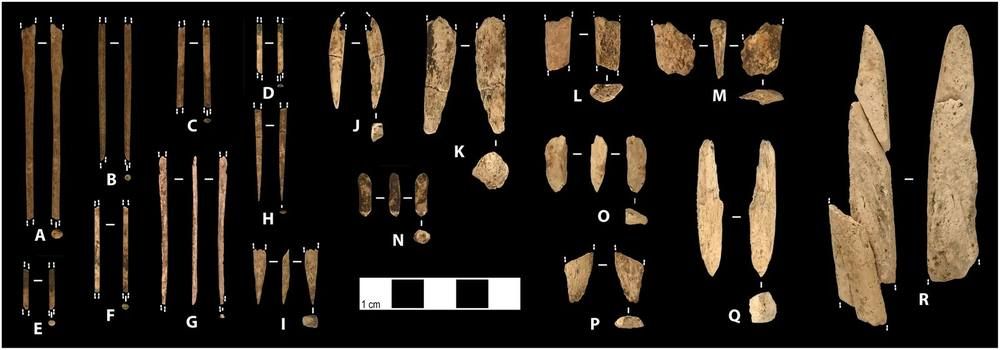
The tools spread the story out geographically. The paper reports eight bone needle fragments, four of which still retain parts of their eyes, along with an antler pendant with a drilled hole and a bone awl tip. Live Science, reading the study, says these are the oldest eyed needles in the Western Hemisphere, because the only eyed needles found earlier came from Paleoindian sites in temperate North America.
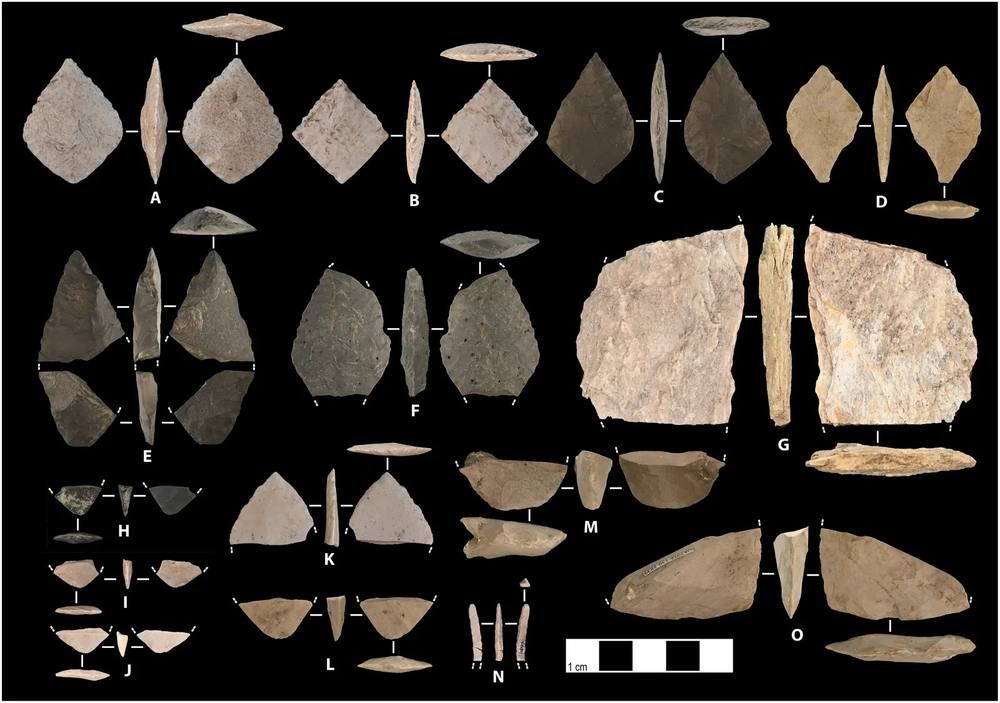
There are six diamond-shaped, edge-ground stone blades, among a larger set of flaked tools. The authors are careful not to call them projectile points, because without use-wear analysis it is not certain they were mounted on spears. They call them hafted bifaces. Similar bipointed, diamond-shaped bifaces have been found at Siberian sites such as Nikita Lake and Berelekh, in the Yana-Indigirka lowland of northeastern Russia, which the paper treats as roughly contemporary.
The stone itself traveled. Rhyolite makes up about seventy percent of the stone tools, and about ninety percent of the rhyolite tested comes from a source nobody has located, though it turns up in early Nenana Valley sites. A single piece traces to Triple Lakes, 115 kilometers away. There are also twenty-five pieces of obsidian, a volcanic glass, all matching a source called Batza Téna about 370 kilometers to the northwest.
So the camp points two directions at once. The blades look west, toward Siberia. The needles, the pendant and some other forms look south, toward sites on the other side of the ice sheets. The authors write that the combination highlights "the strong cultural connection between early Beringians and Americans." That is a modest claim with a large implication, because it suggests the people of interior Alaska were not an isolated dead end. Graf was more cautious in remarks reported by Live Science: "It would be hard to pin down whether or not they were moving back and forth during a lifetime, but at least we can say there is a connection."
The animals eaten at the camp are just as informative. Of 373 bones identified taxonomically, 164 are bison, 16 are caribou, 12 are mammoth, 2 are horse and one is musk ox. There are also arctic hare, foxes, lynx, lemming, a wide range of birds, and, most intriguing of all, fifteen bones of wolf and nine more identified only as Canis, the dog and wolf genus.
§ 6The wolf, or the dog
This is where the headlines run furthest ahead of the evidence. IFLScience's headline says the site might hold the earliest domestic dogs, and the "might" is accurate. The paper does not claim dogs. What it reports is a wolf-like right mandible that was analyzed by two-dimensional geometric morphometrics. The jaw does not share shape space with dire wolves, Pleistocene Beringian wolves or modern wolves of the northern United States. Popular Mechanics reports that it came from a population of wolf-like canids unique to central Alaska. The dog idea comes from the authors noting that genetic evidence suggests Siberian wolves gave rise to early dogs in North America, and that the camp has links to Siberia.
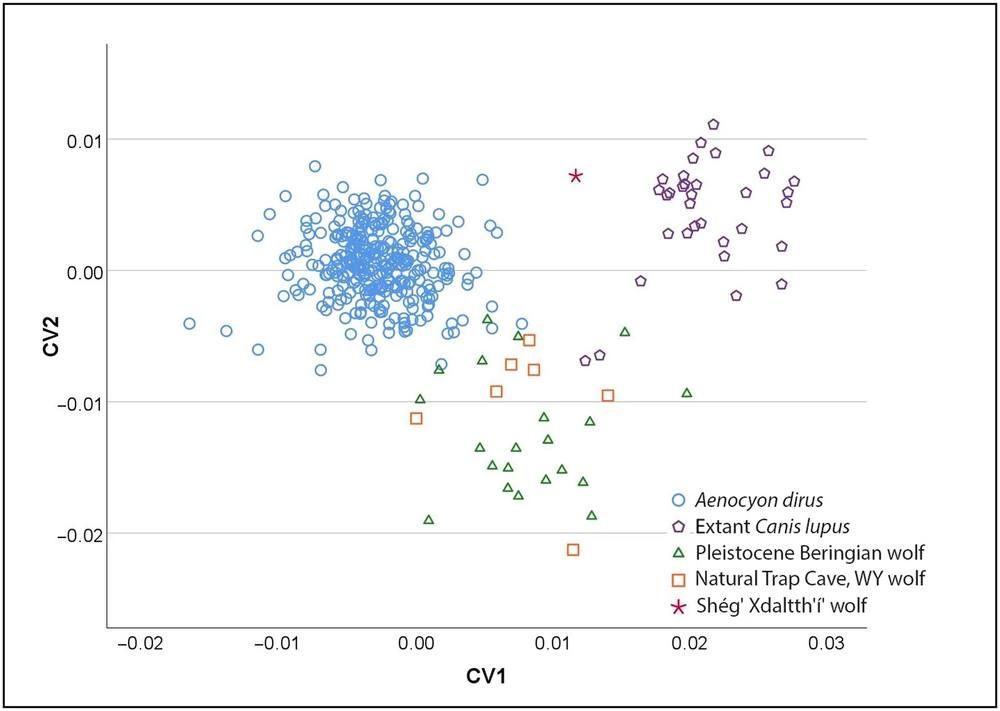
A 2021 study in PNAS by Angela Perri and colleagues argued that dogs were domesticated in Siberia and dispersed into the Americas alongside people. A camp where people stayed for generations, ate a lot of meat and left a lot of waste is also the kind of place wild canids might be drawn to, or tamed. The archaeologist Keenan Britt, in a post on the fauna, treats the canid question as intriguing and open, and stresses that this is early work. The paper itself says that in-depth morphometric and protein analyses are ongoing. Wolves can be at a camp for many reasons, from being hunted to scavenging. A jaw that does not match a wolf is not yet a dog. The safest reading is that the site contains something unusual that deserves more work, which is a long way from "the earliest pet dogs."
§ 7Beringia: a bridge, and a homeland
To see why the location matters, it helps to step back to the geography. During the last ice age, so much water was locked in glaciers that sea level fell by up to about three hundred feet, according to the National Park Service, and the shallow floor of the Bering Sea became dry land. The Park Service defines Beringia as the region bounded on the west by the Lena River in Russia and on the east by the Mackenzie River in Canada. It was not a thin bridge but a vast landscape. The word "bridge" in the popular story undersells it. The Park Service also notes that current genetic research suggests people were isolated from the Siberian mainland there for thousands of years.
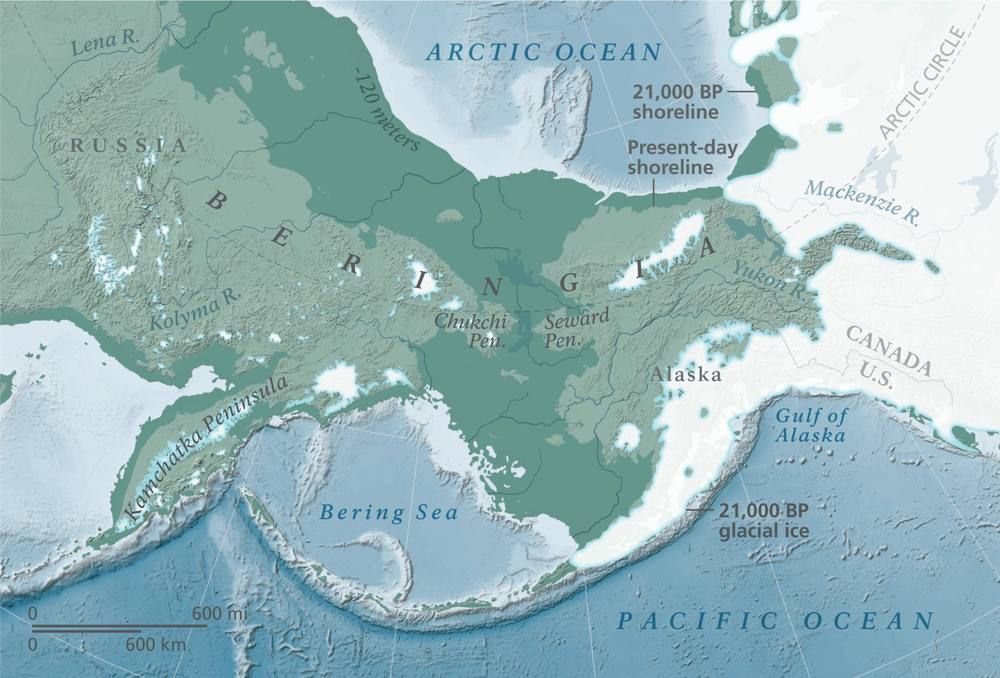

That is the idea behind what geneticists call the Beringian standstill, first proposed in 2007 by Erika Tamm and colleagues from mitochondrial DNA: a population cut off in Beringia, perhaps for several thousand years, before some of them moved south. The authors of the new paper are blunt about the limits. They write that resolving how the archaeological and genetic models fit together "will require ancient genomes" from people who lived in this period. Ancient DNA exists from an infant buried about 11,500 years ago at Upward Sun River, also in the Tanana region, whose genome Moreno-Mayar and colleagues reported in 2018. There is none from anything as old as this camp.
In this frame, Shég' Xdaltth'í' is valuable as a data point from interior eastern Beringia, where most sites are thin. The paper places the start of the Clovis era at about 13,200 years ago, so by its dates this camp predates Clovis by roughly six hundred years, a comparison that is simple arithmetic from the paper's own figures rather than a statement the authors make. It suggests that people were well established in interior Alaska, with rich toolkits, before the Clovis era.
§ 8What it does to the Clovis-first story
For most of the twentieth century, the textbook answer was "Clovis first." In 1932, the archaeologist Edgar Howard began digging near Clovis, New Mexico, where distinctive fluted spear points lay among mammoth bones, as Smithsonian Magazine tells the story. The Clovis people were taught as the first Americans, thought to have walked through an ice-free corridor between two great glaciers in Canada, and their points spread across North America in a few centuries. Smithsonian gives 13,500 years for the oldest securely dated points, while the Alaskan paper uses 13,200 as the start of the Clovis era, so even that date depends on who is counting. Anyone claiming an older site had to clear a very high bar, and for decades few did.
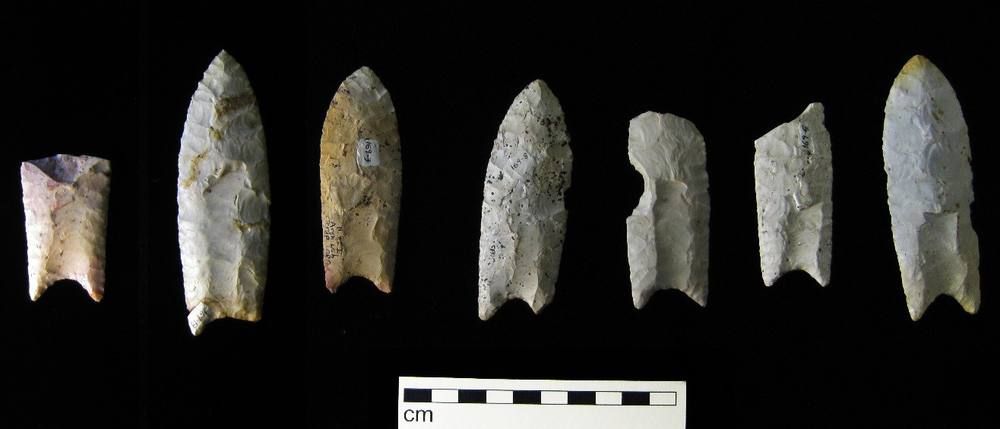

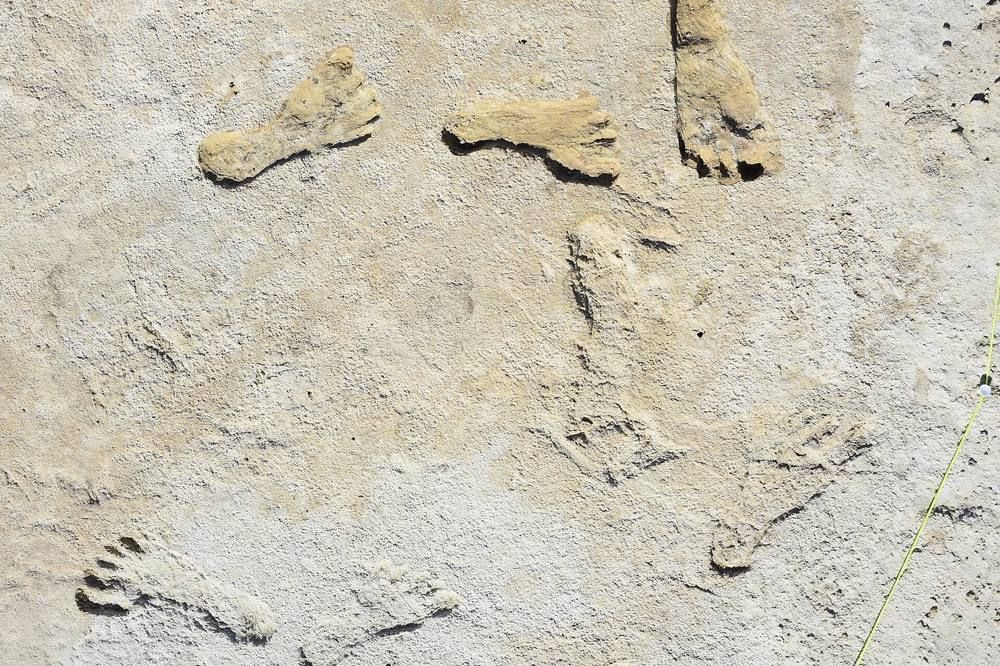
That model has been taking damage for decades. Monte Verde in Chile, reported at about 14,500 years ago, was accepted in 1997 by a group of visiting Paleoindian specialists, several of them former skeptics of pre-Clovis claims. Cooper's Ferry in Idaho has stemmed points and, in a 2019 study in Science by Loren Davis and colleagues, an age between 16,560 and 15,280 years ago. At the Gault site in Texas, Thomas Williams and colleagues reported in 2018 that people were there before about sixteen thousand years ago. And in 2021, the White Sands footprints in New Mexico were dated by seeds to between 23,000 and 21,000 years ago, a date that later studies in 2023 and 2025 say they have supported with other methods, and that some archaeologists still question. Few researchers still defend a strict Clovis-first. The argument now is about how early, how many routes and how many waves.

So one idea in the headlines needs pushing back on: that this Alaskan camp "collapses" Clovis-first. It does not. It is older than Clovis but fits comfortably in almost any version of the story. An invited perspective piece in the same journal issue, by the archaeologist Spencer Pelton, makes a related point. Pelton titled it "Shég' Xdaltth'í' and the enduring value of old ideas." According to Live Science, he wrote that early Indigenous sites in Beringia are key to understanding the peopling of the Americas. In plain terms, the paper can be read as evidence for a long Beringian presence, without telling us that any of the other early sites farther south are right.
§ 9The other early sites, and a 2026 shake-up
The contested sites are best treated one at a time, because 2026 has been an eventful year.
Monte Verde was for almost thirty years the keystone of the pre-Clovis case. In March 2026 a team led by Todd Surovell published a paper in Science arguing that radiocarbon and luminescence dates, together with a tephra dated to 11,000 years ago that they say lies stratigraphically below the archaeological component, mean that Monte Verde cannot be older than the Middle Holocene, 8,200 to 4,200 years ago. Tom Dillehay, who led the original excavations, and colleagues have published a detailed rebuttal. It says the Surovell team did not excavate the site, misidentified the tephra and upheld the original late Pleistocene interpretation. The dispute is active and unresolved, and a reader who says that Monte Verde is "proven" or "disproven" today is ahead of the evidence.
White Sands has its own story. The first dating, in 2021, used seeds of an aquatic plant, a method criticized because aquatic plants can take up old carbon. A 2023 study in Science led by Jeffrey Pigati dated terrestrial pollen from the same layers, along with luminescence ages of the sediments, and reported that the original chronology is robust. A 2025 study led by Vance Holliday added 26 more radiocarbon dates on lake mud, run by two laboratories independent of the original investigators, and reported that the evidence supports a Last Glacial Maximum age for the footprints.
Cooper's Ferry in Idaho is one of the stronger cases for a presence south of the ice around 16,000 years ago, and its excavators note that its stemmed points resemble those from Upper Paleolithic Japan, which has fed the idea of a coastal route. The Alaskan paper also mentions Bluefish Caves in the Yukon and Yana in Siberia, where claims of far older human activity have been made, as possible hints of an earlier presence in Beringia.
The Alaskan camp does not settle any of those arguments. What it adds is a well-documented base on the northern side of the continent.
§ 10The coastal route and the ice-free corridor
The two classic routes south are inland and coastal. The inland route, through an ice-free corridor between the two great ice sheets in what is now Alberta and the Yukon, was the old textbook path. A 2016 study in Nature by Mikkel Pedersen and colleagues, using lake sediment cores with pollen and ancient DNA, found that the corridor became biologically viable only around 12,600 years ago, and concluded that the first Americans before that time were unlikely to have used it. The coastal route proposes that people in boats, following a "kelp highway" of rich shoreline resources, an idea Jon Erlandson and colleagues put forward in 2007, skirted the ice along the Pacific coast. Davis and colleagues argued in 2019 that the Cooper's Ferry dates make a Pacific coastal route the probable one.
An interior Alaskan camp says little about this directly, and the authors do not claim otherwise. It is an inland site. What it shows is the toolkit early Alaskans had: sewn clothing, earth ovens, shelters, and the skill to hunt large animals. People like that were able to travel.
§ 11The Younger Dryas
About 12,900 years ago, give or take a century, the climate in much of the Northern Hemisphere abruptly turned cold again for about twelve hundred years, in an episode called the Younger Dryas. The authors of the Alaskan paper note that their Component 2b, dated to around 12,800 to 12,600 years ago, correlates with the early Younger Dryas, when an abrupt return to gusty conditions is recorded in the nearby Nenana Valley, and they discuss signs of elevated sand deposition at the site afterward. They do not report any evidence of an impact or other catastrophe in the main text of the study.
That matters because of the Younger Dryas impact hypothesis, proposed in 2007 by Richard Firestone, Allen West, James Kennett and colleagues in the Proceedings of the National Academy of Sciences. It says an extraterrestrial impact about 12,900 years ago contributed to the cooling, to the extinction of large animals and to the end of the Clovis culture. Many specialists have not accepted it. A 2023 review by Holliday and colleagues in Earth-Science Reviews, titled "Comprehensive refutation of the Younger Dryas Impact Hypothesis," is the most thorough statement of that case. The proponents answered in 2024 with a paper titled "Rejection of Holliday et al.'s alleged refutation," and Holliday's team published a rebuttal of that reply, so the dispute is formally still open. The summary is that it remains a minority position, still argued, and is not supported by the Alaskan paper.
§ 12What the skeptics say
No published rebuttal to this specific paper turned up in the weeks since its release, which is not surprising. The questions a careful skeptic would put to it follow from the paper's own caveats and the usual debates, not from named critics.
First, the dwelling. A charcoal-stained oval and a possible postmold are suggestive, but a single such feature in a block of twenty-five square meters is a thin basis for a claim of the earliest structure. The authors say as much with the word "potential." Second, the date model. Removing outliers is common practice, but it is a decision, and the narrowing of the range hides a possible longer, patchier use of the place, which the authors admit. Third, the dog. All that exists is a jaw that does not match the comparison wolves, with protein and genetic work still to come. Fourth, the claim of a base camp rests on interpretation of artifact density and variety, and a place visited many times can look like a base camp when it is really a palimpsest of short stays. The authors say that detailed analyses are ongoing.
None of these is damning. They are the kind of questions that make a good first paper into a lasting one, and the paper's authors raise several of them themselves.
§ 13The alternative view
Graham Hancock and others argue that an advanced, lost civilization was destroyed at the end of the last ice age, around the time of the Younger Dryas. How does this site look from that vantage?
In one way, it fits a point they make. Hancock and his supporters argue that mainstream archaeology has repeatedly underestimated how old and how capable early humans were, and the Clovis-first story is a real example of an orthodoxy that was wrong for decades. A site with sewn clothing, earth ovens and long-distance stone trade at 13,800 years ago is a reminder that ice age people were skilled and should not be caricatured as only chasing mammoths.
In another way, it points the other direction. The site shows ordinary hunter-gatherer technology: stone, bone, hide and fire. It shows no metals, no monumental architecture and no sign of a complex society. Hancock has also written about Alaska before. In a 2017 post, he asked whether the frozen muck of the Fairbanks region, which is full of mammoth and other bones, might be evidence of a giant cataclysm. The paper describes the site as well stratified, with occupation layers separated by wind-blown silt. The paper does not address the muck-deposit argument, but that kind of orderly layering is not what a catastrophic disturbance would be expected to leave. Hancock's website lists coverage of the Alaska find on its news page, but no commentary by him on the paper turned up. The mainstream response is that the field did overturn Clovis-first, through the evidence, in public, and led by archaeologists. The alternative view's response is that it took far too long. Both are fair points, and the evidence in this paper does not decide between them.
§ 14How the news landed
Coverage was broad and mostly sound on the facts. The University of Kansas issued a news release, which is linked in the sources. Live Science and Popular Mechanics led with "oldest dwelling" and "rewriting how the Americas were settled," framing the paper itself avoids, though Popular Mechanics also quotes the paper's cautious language. Discover Magazine focused on the diamond-shaped tools, IFLScience on the dog question, and Archaeology News Online Magazine on the links to Siberia. The most careful treatment came from outside the news cycle, in Keenan Britt's post on the fauna and in Pelton's perspective piece. As usual, the headlines carried more than the articles did.
§ 15What would settle it
For most of the last century, the story was simple: Clovis people arrived around 13,000 years ago and filled two continents. Then Monte Verde, Cooper's Ferry, White Sands and others pushed the date back and made the picture messy. In 2026 the picture got messier, with Monte Verde itself under challenge. Into that argument comes a camp in Alaska, dated to about 13,800 years ago, with a probable shelter, a fire, an earth oven, eyed needles, diamond-shaped blades and a wolf-like jaw that does not match its comparison groups. It does not overthrow anything. What it does is show, carefully and in detail, that people in interior eastern Beringia were settled, skilled and connected both to Asia and to the south, before Clovis.
What would real investigation look like from here? First, ancient DNA and protein analysis of the canid bones, to say whether the jaw belongs to a wolf, a dog or something else. Second, use-wear and residue studies on the diamond blades, to show whether they were spear tips, knives or something else. Third, soil studies of the oval stain, with micromorphology and plant microfossils, to test the lean-to reading, and sediment DNA, which can reveal the animals and sometimes the people in a layer. Fourth, independent re-dating by other laboratories and open release of the data, so the Bayesian model can be re-run with different choices. Fifth, much more excavation, since the dug area is a sliver of the site. Sixth, continued partnership with the Indigenous communities whose ancestors, in the elders' words, were there, which the authors say has been part of the project. Beyond this one site, the field needs human remains and genomes from that period, and a calm, evidence-first resolution of the Monte Verde and White Sands disputes. For the alternative view, the equivalent test is the same one it always is: bring datable, independently checkable physical evidence, and let blind laboratories test it.
A group of people stayed in one place by a river, made their lives there, and left behind enough that it can still be read 13,800 years later. They were there.
Watch & Listen
Hear this entry read aloud. Coming soon — the channels are not live yet.
Sources
The study and primary sources
- Graf et al., "Highlights from an early base camp in Beringia 13,800 years ago: Shég' Xdaltth'í' and the Late Pleistocene peopling of Alaska," Science Advances 12(42), eaeh0802, October 14, 2026 (CC BY-NC 4.0; publisher site blocks automated access)
- Same paper, open full text and figures on PubMed Central (PMC13666009)
- Pelton, "Shég' Xdaltth'í' and the enduring value of old ideas," Science Advances perspective, October 16, 2026 (publisher site blocks automated access)
- University of Kansas News, "Bering Land Bridge base camp reveals what life was like nearly 14,000 years ago"
- Keenan Britt, "The surprising animal bones from Alaska's 13,800-year-old Shég' Xdaltth'í' site," Digging Deeper
- National Park Service, Beringia
Context papers and debates (DOI links resolve in Crossref; several publisher sites block automated access)
- Meltzer et al., "On the Pleistocene Antiquity of Monte Verde, Southern Chile," American Antiquity (1997)
- Davis et al., "Late Upper Paleolithic occupation at Cooper's Ferry, Idaho, USA, ~16,000 years ago," Science (2019)
- Williams et al., "Evidence of an early projectile point technology in North America at the Gault Site, Texas, USA," Science Advances (2018)
- Bennett et al., "Evidence of humans in North America during the Last Glacial Maximum," Science (2021), the seed dating of the White Sands footprints
- Pigati et al., "Independent age estimates resolve the controversy of ancient human footprints at White Sands," Science (2023)
- Holliday et al., "Paleolake geochronology supports Last Glacial Maximum (LGM) age for human tracks at White Sands, New Mexico," Science Advances (2025)
- Pedersen et al., "Postglacial viability and colonization in North America's ice-free corridor," Nature (2016)
- Erlandson et al., "The Kelp Highway Hypothesis," Journal of Island and Coastal Archaeology (2007)
- Tamm et al., "Beringian Standstill and Spread of Native American Founders," PLoS ONE (2007)
- Moreno-Mayar et al., "Terminal Pleistocene Alaskan genome reveals first founding population of Native Americans," Nature (2018)
- Charles C. Mann, "The Clovis Point and the Discovery of America's First Culture," Smithsonian Magazine
- Firestone et al., "Evidence for an extraterrestrial impact 12,900 years ago that contributed to the megafaunal extinctions and the Younger Dryas cooling," PNAS (2007)
- Holliday et al., "Comprehensive refutation of the Younger Dryas Impact Hypothesis (YDIH)," Earth-Science Reviews (2023)
- Proponents' reply, "Rejection of Holliday et al.'s alleged refutation of the Younger Dryas impact hypothesis," Earth-Science Reviews (2024)
- Holliday et al., rebuttal to the proponents' reply, Earth-Science Reviews (2024)
- Perri et al., "Dog domestication and the dual dispersal of people and dogs into the Americas," PNAS (2021)
- Surovell et al., "A mid-Holocene age for Monte Verde challenges the timeline of human colonization of South America," Science, March 19, 2026
- Dillehay et al., rebuttal to Surovell et al. on Monte Verde (Fundación Monte Verde, May 2026)
- Graham Hancock, "Muck, Mammoths and Extinctions" (2017)
- Graham Hancock's site, News Desk (lists coverage of the Alaska find)
News coverage
- Popular Mechanics, 13,800-year-old Alaskan base camp
- Live Science, "Archaeologists discover the oldest dwelling in the Western Hemisphere at a 13,800-year-old site in Alaska"
- IFLScience, "At 13,800 Years Old, This Is The Oldest Known Dwelling In The Americas - With What Might Be Its Earliest Domestic Dogs"
- Discover Magazine, "13,800-Year-Old Alaskan Base Camp Reveals Rare Diamond-Shaped Stone Tools"
- Archaeology News Online Magazine, "13,800-year-old Alaska camp reveals how Ice Age hunters lived near the Bering Land Bridge"
Reference pages (Wikipedia and Grokipedia, cross-checked against the primary and credible sources above; no claim rests on these alone)
- Peopling of the Americas: en.wikipedia.org/wiki/Peopling_of_the_Americas, with Grokipedia: grokipedia.com/page/Peopling_of_the_Americas
- Beringia: en.wikipedia.org/wiki/Beringia, with Grokipedia: grokipedia.com/page/Beringia
- Clovis culture: en.wikipedia.org/wiki/Clovis_culture, with Grokipedia: grokipedia.com/page/Clovis_culture
- Clovis first
- Monte Verde: en.wikipedia.org/wiki/Monte_Verde, with Grokipedia: grokipedia.com/page/Monte_Verde
- White Sands fossil footprints
- White Sands National Park: en.wikipedia.org/wiki/White_Sands_National_Park, with Grokipedia: grokipedia.com/page/White_Sands_National_Park
- Cooper's Ferry site: en.wikipedia.org/wiki/Cooper%27s_Ferry_site, with Grokipedia: grokipedia.com/page/Cooper%27s_Ferry_site
- Bluefish Caves: en.wikipedia.org/wiki/Bluefish_Caves, with Grokipedia: grokipedia.com/page/Bluefish_Caves
- Upward Sun River site
- Berelekh
- Coastal migration
- Domestication of the dog: en.wikipedia.org/wiki/Domestication_of_the_dog, with Grokipedia: grokipedia.com/page/Domestication_of_the_dog
- Younger Dryas: en.wikipedia.org/wiki/Younger_Dryas, with Grokipedia: grokipedia.com/page/Younger_Dryas
- Younger Dryas impact hypothesis: en.wikipedia.org/wiki/Younger_Dryas_impact_hypothesis, with Grokipedia: grokipedia.com/page/Younger_Dryas_impact_hypothesis
- Graham Hancock: en.wikipedia.org/wiki/Graham_Hancock, with Grokipedia: grokipedia.com/page/Graham_Hancock
- Tanana River: en.wikipedia.org/wiki/Tanana_River, with Grokipedia: grokipedia.com/page/Tanana_River
Images (all credited under each picture)
- Figures 1 to 6 and 8 from Graf et al. 2026 (CC BY-NC 4.0; figures 6 and 8 photographs by B. Potter, University of Kansas)
- Wikimedia Commons: White Sands footprints (NPS, public domain), Beringia map (NPS, public domain), Tanana River (public domain), Clovis points (Bill Whittaker, CC BY-SA 3.0); file pages are linked in each image credit.